
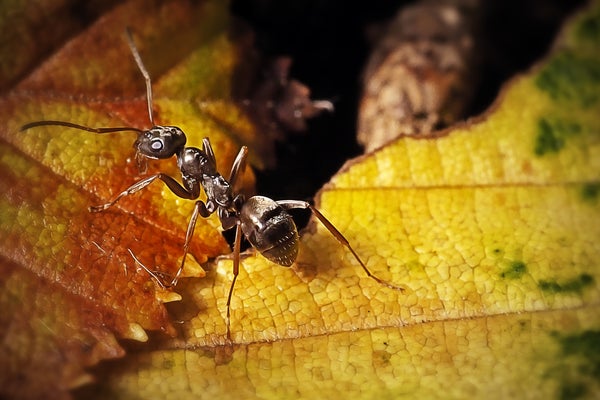
Ants don’t have a nose, but that doesn’t stop them from sniffing out cancer. Thanks to an abundance of olfactory receptors on their antennae, the insects have an incredible sense of smell—and they can use it to detect tumors.
Cancerous tumors release distinctive versions of chemicals called volatile organic compounds that often show up in bodily fluids such as sweat and urine and in breath vapor. Ants can sniff out those compounds in urine, according to a new study published in the Proceedings of the Royal Society B. The insects could be used one day as a less expensive, noninvasive detection method for cancer, the study authors say.
“This is an exciting direction,” says biomedical engineer Debajit Saha, who experiments with cancer-detecting locusts at Michigan State University and was not involved with the new study. He adds that harnessing insect biology is a “new and very powerful approach to disease detection.”
On supporting science journalism
If you're enjoying this article, consider supporting our award-winning journalism by subscribing. By purchasing a subscription you are helping to ensure the future of impactful stories about the discoveries and ideas shaping our world today.
Baptiste Piqueret, an ethologist at Sorbonne Paris North University and lead author of the study, already knew that ants could detect the volatile organic compounds wafting off cancer cells. He previously discovered that he could train the ant species Formica fusca to distinguish between cancer cells and healthy cells grown in culture. Now he’s taken the research one step further by using actual tumors.
Piqueret and his team started by transplanting human breast cancer tumors into mice and letting them grow—a technique called xenografting. They then collected urine from both tumor-laden mice and healthy ones. By placing a drop of sugar water in front of the urine from animals with cancer, the researchers trained the ants to associate the smell of tumors with a reward. When the team removed the sugar water, the insects lingered around the pee of cancerous mice for about 20 percent longer than that of healthy mice because they were looking for a sweet treat.
It only took three training rounds, around 10 minutes total, to lock in the ants’ smell association. That’s considerably faster than training cancer-smelling dogs, for instance, which can take around six months. “That’s something we were not expecting, to see it that fast,” Piqueret says.
Globally, cancer is responsible for around one in six deaths, making it a leading cause of mortality. Early detection is a crucial factor in successful treatment, but current screening methods can be invasive or inaccessible because of cost. Although the prospect of an ant-powered early-detection tool is exciting, Piqueret emphasizes that the study is only a proof of concept: the research is still far from any kind of clinical application. Compared with a highly controlled lab environment with mice as subjects, real-life patients will introduce many variables—including age, sex and diet—that could affect results. And the tumors detected in the new study were proportionally large for mice. Next, the researchers will investigate how small a tumor can be before it goes undetected, and they will scale up the study by using urine from humans with particular cancers.
Meanwhile there’s no need to worry about one day having ants crawl all over you for science, Piqueret says: if the insects are ever employed as cancer sniffers in the future, patients will supply a urine sample that ants can analyze in a separate lab.