
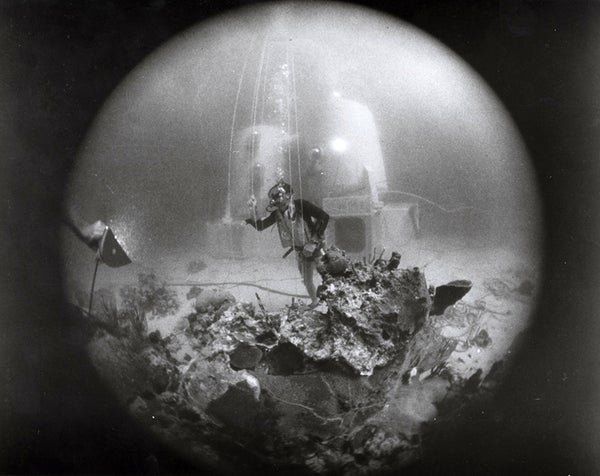
Mark Patterson was living underwater for a week inside the Hydrolab, a white, cylindrical research station at the bottom of the ocean in the eastern Caribbean. It was 1984, and he was on his first of what would become many missions involving saturation diving: descending to the seafloor and spending multiple days there, leaving the lab during the day to explore the underwater world as an aquanaut. After acclimating to the depths, he couldn’t ascend even if he wanted to. To avoid dire health consequences, he would have to spend 24 hours for every 100 feet of depth slowly decompressing when the mission ended.
Patterson wanted to dive at night. He put on his gear, opened the hatches and swam out into the sea, a 300-foot-long cord tethering him to the lab. When the cord pulled taut, he sat down on the sandy ocean floor. The lab glowed like a jewel in the distance, and around him bioluminescent plankton shone like stars. “That’s when I felt, ‘Wow, this is the coolest thing maybe I’m ever going to do: live underwater,’” says Patterson, a marine biologist at Northeastern University who has spent a total of 89 days under the sea.
Patterson experienced what scientists have called the “underview effect,” an intense sensation of awe that strengthens aquanauts’ perception of human connectedness to the world. The experience’s name references the so-called overview effect astronauts describe feeling when looking at Earth from orbit. Patterson was one of the 14 aquanauts who discussed their experiences of awe for a study in Environment and Behavior.
On supporting science journalism
If you're enjoying this article, consider supporting our award-winning journalism by subscribing. By purchasing a subscription you are helping to ensure the future of impactful stories about the discoveries and ideas shaping our world today.
Many of those surveyed reported that the length of observation—aquanauts’ daily excursions can last eight hours—is part of what makes the experience special. A moray eel or a barracuda becomes an individual with daily habits and behaviors. Storms overhead alter pressure below the surface and make ears pop. Plankton undulate with the movement of the waves.
Previous studies have concluded that the overview effect helped astronauts and the people who heard their stories become more attuned to how human behavior has altered Earth. The new study’s authors suggest that descriptions of awe-inspiring time underwater could help others think differently about the seas.
Inducing awe is “one of the strongest ways to weaken the boundaries of ourselves,” says Stanford University psychologist Johannes Eichstaedt, who has studied the overview effect and was not involved in the recent paper. It can generate a sense of connection to nature for some people, he adds.
Lead study author Kristen Kilgallen, a psychology Ph.D. candidate at Northeastern, suggests that awe in the natural world can come simply from trying something new that disrupts everyday routines. “You can find exploration rewarding in and of itself, regardless of what you find,” she says. “That’s what keeps you engaged with the world.”