New Issue: Science’s Impossible Questions. Read Now

Disappearing Arctic sea ice breaks frightening record

The Arctic sea ice maximum this year effectively tied for the lowest ever on record, with major implications for polar ecosystems and global warming

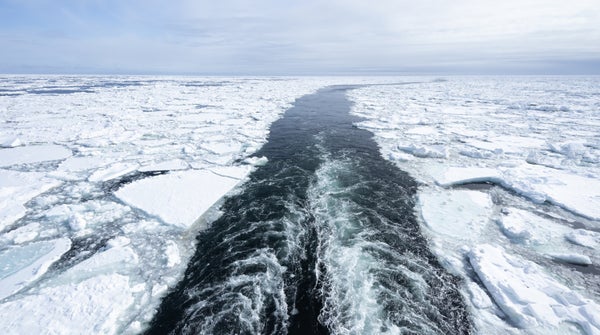
Floating ice split by a boat's wake; the boat is not visible.

Sea ice breaking in Svalbard after a ship passes through.

MB Photography/Getty Images

Join Our Community of Science Lovers!

The shell of ice that expands atop the Arctic Ocean every winter has done all the growing it will do this season—and that hasn’t been much. In fact, the annual winter maximum sea ice extent this year has tied for the record lowest amount in the nearly 50 years that satellites have been keeping watch.

“This record low maximum gives a head start to the spring and summer melt season,” said Walt Meier, senior research scientist at the National Snow and Ice Data Center (NSIDC), in a press release.

The expanse of Arctic Ocean covered by ice grew to 14.29 million square kilometers (5.52 million square miles), likely peaking on March 15, NSIDC reported on Thursday. This is just below a past record low of 14.31 million km2 (5.53 million square miles) set last year, but anything within 40,000 km2 (15,000 square miles) is considered a tie.


On supporting science journalism

If you're enjoying this article, consider supporting our award-winning journalism by subscribing. By purchasing a subscription you are helping to ensure the future of impactful stories about the discoveries and ideas shaping our world today.


The record underscores the rapid loss of Earth’s northern polar ice cap, driven by the human-caused rise in global temperatures. This year’s winter low was 1.36 million km2 (525,000 square miles) below the 1981–2010 average. That’s a loss of ice about twice the size of Texas.

The disappearance of Arctic ice—which is even more pronounced in the summer months—not only threatens fragile polar habitats and the species that live there; it also exacerbates global warming. The ice is naturally reflective, sending some of the sun’s rays back out to space. But the darker open ocean absorbs those rays, raising temperatures and driving further ice melt.

“One or two record low years don’t necessarily mean much by themselves, but in the context of the significant downward trend that we’ve observed since 1979, it reinforces the dramatic change to Arctic sea ice throughout all seasons,” Meier said.

Some scientists have projected that the Arctic will experience its first ice-free day—defined as the moment when ice cover shrinks below one million km2 (386,000 square miles)—before the end of the decade. The pace of ice loss and the implications have spurred some researchers to see if we can refreeze the Arctic, for example, by pumping colder deep ocean water on existing sea ice.

Andrea Thompson is senior editor for Earth and environment at Scientific American, covering the environment, energy and Earth sciences. She has been covering these topics for nearly two decades. Prior to joining Scientific American, she was a senior writer covering climate science at Climate Central and a reporter and editor at Live Science, where she primarily covered earth science and the environment. She has moderated panels, including as part of the United Nations Sustainable Development Media Zone, and appeared in radio and television interviews on major networks. She holds a graduate degree in science, health and environmental reporting from New York University, as well as a B.S. and an M.S. in atmospheric chemistry from the Georgia Institute of Technology. Follow Thompson on Bluesky @andreatweather.bsky.social

More by Andrea Thompson

Subscribe to Support Independent Journalism

Great science journalism requires human expertise, time, effort and creativity. And it costs money. That’s why I and the journalists here at Scientific American hope you’ll join our community.

When you subscribe, you are supporting staff and freelance journalists who are passionate about telling science stories that are true, important and compelling. Our editors and reporters are often experts in their fields, which means they understand the nuances of big discoveries and can untangle the breakthroughs from the hype. With a subscription, you are also supporting rigorous fact-checking to ensure the words we publish are precise and accurate. And you’re supporting original illustrations, graphics and photos that bring you closer to an advanced laboratory, an ice sheet in Antarctica or a space mission in orbit. You’re helping us craft other types of high-quality journalism as well: Our newsletters are carefully written, edited and curated by staffers you have or will come to know and love. Our Science Quickly podcast is based on original reporting, collaboration with editors and scientists and exacting production.

Subscriptions keep this engine running so we can continue to deliver thoughtful, rigorous and independent science journalism to you. In an era of viral misinformation, this work is crucial. If you value what we do, I hope you’ll consider joining us as a subscriber

Thank you,

Jeanna Bryner, Editor in Chief, Scientific American

Subscribe