
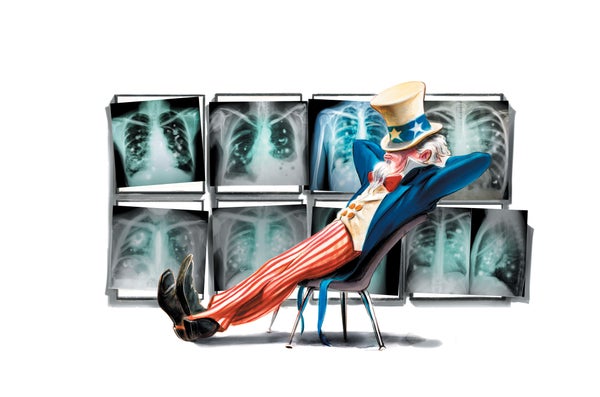
In March the U.S. Environmental Protection Agency announced that it was banning ongoing uses of asbestos. People might have thought, Wait—what? Wasn’t it already banned? After all, many remember asbestos—a naturally occurring, fibrous mineral that is resistant to heat and flame but is also toxic and carcinogenic—being removed from schools and hospitals across the U.S. starting in the 1970s. The new EPA decision is welcome, of course, but it highlights the need to figure out a better process for dispensing with deadly products.
Scientific understanding of the harms of asbestos can be traced back to 1898, when British factory inspector Lucy Deane described asbestos manufacturing as one of four dusty occupations worthy of scientific observation because of “their easily demonstrated danger to the health of workers.” In 1927 the term “asbestosis” was adopted to describe a devastating lung disease often seen in asbestos workers, and doctors began to notice that victims of asbestosis often also developed lung cancer.
More than 30 years passed before the asbestos-cancer link was firmly established, however. In 1960 a book published by E. I. du Pont de Nemours & Company openly acknowledged that “pulmonary carcinoma has been observed with such high frequency in employees of the asbestos industry that a causal relationship has been accepted by most authorities.” Four years later Irving J. Selikoff, a doctor and researcher at Mount Sinai Hospital in New York City, tied together various lines of investigation in a now classic study. He found a statistically significant higher incidence of mesothelioma—an otherwise extremely rare cancer—in workers exposed to asbestos compared with that in the general population. Asbestos exposure also led to increased rates of lung, pleura, stomach, colon and rectal cancers. Crucially, the evidence indicated that there was no safe level of exposure.
On supporting science journalism
If you're enjoying this article, consider supporting our award-winning journalism by subscribing. By purchasing a subscription you are helping to ensure the future of impactful stories about the discoveries and ideas shaping our world today.
At a 1964 New York Academy of Sciences conference on asbestos, industry representatives agreed that the only way to prevent cancers caused by asbestos exposure was to eliminate that exposure. And so, in the 1970s, many nations began to ban asbestos. As of 2020, at least 67 countries had banned asbestos use either entirely or with very limited exemptions.
Because of the long latency period of many cancers caused by asbestos—and the difficulty of knowing all the circumstances in which people might have been exposed to asbestos outside industrial settings—it is hard to say just how many people have died or are still dying from asbestos. The University of Washington–based Institute for Health Metrics and Evaluation estimates that asbestos caused more than 40,764 worker deaths in 2019 alone; this figure does not include deaths outside industrial settings, such as those of family members exposed to asbestos brought home on a worker’s clothes or shoes.
According to the U.S. Centers for Disease Control and Prevention, between 1999 and 2015 there were 45,221 mesothelioma deaths in the U.S. The cumulative number of occupational deaths that were caused by asbestos over the course of the 20th century may be something on the order of 17 million, with perhaps another two million deaths from nonoccupational exposures.
Yet until now, only various partial and limited bans have been in place in the U.S.
It’s generally impossible to say why something didn’t happen in a given situation. But in this case, industry pushback, aided by antiregulatory attitudes that have dominated in the U.S. since the 1980s, clearly played a role. In 1989 the EPA tried to use its authority under the Toxic Substances Control Act (TOSCA) to phase out and ultimately ban most asbestos-containing products. But a company named Corrosion Proof Fittings, backed by several trade associations, successfully challenged the rule in federal court. The plaintiffs claimed that the agency’s rule would save only three lives over the course of 13 years and at “an approximate cost of $128–277 million.” That was patently false, and the court did not accept it. But it did accept a different complaint about the procedure by which the EPA had come to its proposed remedy.
The EPA could have proposed a new rule, but during the 1990s the political tide had turned against “big government” as various industry groups worked to demonize “regulation,” and the EPA stood back. Rather than attempting to propose a new, broad rule under TOSCA, the agency focused on more limited and specific regulations, such as developing guidelines to accredit asbestos-removal personnel, or regulations that were explicitly authorized by Congress.
One such regulation was the 1990 Asbestos School Hazard Abatement Reauthorization Act, which empowered the EPA to help schools deal with asbestos on their grounds. As a result of these choices, asbestos use was greatly reduced, but it was not eliminated, and a number of asbestos-bearing products remained on the market.
Moreover, throughout the 1990s and 2000s industry groups pursued a strategy similar to that of the tobacco industry, attempting to cast doubt on the science that demonstrated the harms of asbestos. Among other things, they attempted to discredit asbestos researchers—particularly Selikoff—as zealots and to muddy the scientific waters by claiming that only certain mineralogical forms of asbestos were hazardous, when in fact the science supported no such distinction.
In 2016 Congress amended TOSCA to restore to the EPA some of the authority that had been stripped from it by the courts. The asbestos ban is the EPA’s first new rule under the amended law.
America was once a leader in occupational health and safety. Now we are laggards. It took 126 years for us to heed Lucy Deane’s warning about the dangers of asbestos. We need a better way to translate science into policy.