
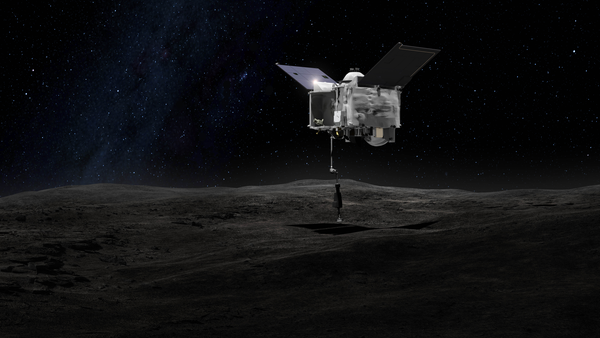
For the second time this year, a spacecraft is about to partner with an asteroid in an intimate dance.
In June, the Japanese mission Hayabusa2 arrived at the 1-kilometre-wide asteroid Ryugu, from whose dusty surface it aims to scoop a sample early next year. On 3 December, the NASA spacecraft OSIRIS-REx will reach an even tinier space rock, named Bennu, in pursuit of the same goal.
OSIRIS-REx will spend the next few weeks buzzing over Bennu’s poles and equator, gathering information to estimate its mass. If all goes well, on 31 December the probe will move even closer to its target—and the 500-metre-wide, diamond-shaped Bennu will become one of the smallest planetary objects ever orbited by a spacecraft.
On supporting science journalism
If you're enjoying this article, consider supporting our award-winning journalism by subscribing. By purchasing a subscription you are helping to ensure the future of impactful stories about the discoveries and ideas shaping our world today.
In July 2020, after a year and a half of in-depth study, OSIRIS-REx will lower itself all the way to Bennu’s surface, stick out a robotic arm and suction up at least 60 grams of asteroid dirt to bring home. If the dirt arrives on Earth in 2023 as planned, it will be the largest planetary sample retrieved since the last Apollo astronauts departed the Moon in 1972.
Pictures of Bennu show a salt-and-pepper surface strewn with at least one large boulder and some slumpy-looking craters. “The bright and dark spots are exciting,” says Dante Lauretta, a planetary scientist at the University of Arizona in Tucson and the mission’s principal investigator. “We’re going to have a lot of fun as we get closer.”
OSIRIS-REx and Hayabusa2 scientists have been sharing data from their respective asteroids. Having two asteroid sample-return missions operating at the same time is a first. Comparing the findings “will be a scientific bonanza”, says Lucy McFadden, a planetary astronomer at NASA’s Goddard Space Flight Center in Greenbelt, Maryland.
The dirt on Bennu
Like Ryugu, Bennu is a dark-coloured asteroid thought to resemble some carbon-rich meteorites found on Earth. OSIRIS-REx researchers chose it as their target because of that similarity, because it is in an orbit and of a size that is easy to visit from Earth, and because it might hit Earth in the twenty-second century. By visiting Bennu, scientists hope to learn more about the forces that affect asteroids moving through space—such as heat that is absorbed and re-radiated by space rocks, which can reduce or increase their risk of hitting Earth.
The US$800-million OSIRIS-REx mission, which launched in 2016, also aims to learn more about the origins of the Solar System. Studying Bennu’s chemical make-up could help researchers to understand how water and prebiotic molecules might have been distributed through the Solar System soon after it formed, some 4.5 billion years ago.
And grabbing a sample of dust of Bennu’s surface will allow engineers to test technologies that could assist with mining asteroids, such as how to fly precisely in near-zero gravity. “Any asteroid-mining endeavour is going to have to understand how to do that,” says Lauretta, who is on the advisory board of Planetary Resources, an asteroid-mining company in Redmond, Washington.
OSIRIS-REx also carries a laser scanner from the Canadian Space Agency, which will build up a 3D picture of the asteroid.
The mission’s acronym and Bennu’s name reference Egyptian mythology. OSIRIS-REx stands for Origins, Spectral Interpretation, Resource Identification, and Security-Regolith Explorer; Osiris is the Egyptian god of the underworld. Bennu is an Egyptian deity often depicted in the shape of a heron, which the spacecraft’s sampling arm supposedly resembles.
This article is reproduced with permission and was first published on November 29, 2018.