
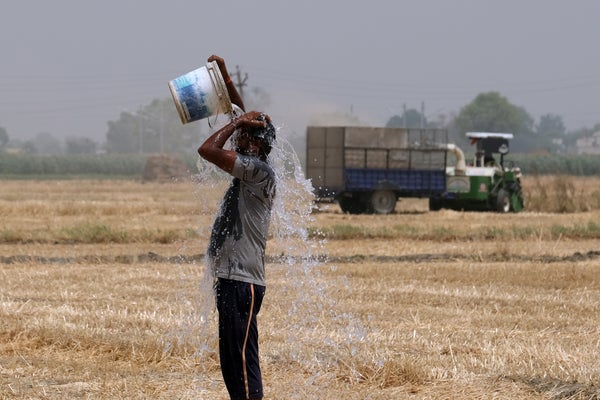
CLIMATEWIRE | A record-breaking heat wave that’s been gripping India and Pakistan for weeks is expected to keep dragging on, meteorologists say.
After an intense weekend, some of the worst heat could be slightly subsiding — but more extreme temperatures may be in store in the coming days.
The region has suffered above-average temperatures for weeks now, affecting hundreds of millions of people. The punishing extremes reached dangerous new levels in the past week.
On supporting science journalism
If you're enjoying this article, consider supporting our award-winning journalism by subscribing. By purchasing a subscription you are helping to ensure the future of impactful stories about the discoveries and ideas shaping our world today.
Cities across the region broke monthly April records. Temperatures have topped 100 degrees Fahrenheit across much of the region and have jumped above 110 F in many areas. New Delhi saw temperatures climb above 110 F for several days on end.
In parts of Pakistan, the heat rose even higher. Jacobabad exceeded 120 F on Saturday, likely the highest temperature recorded anywhere in the Northern Hemisphere last month. The city of Nawabshah topped it the next day with a staggering 121.1 F, according to climatologist Maximiliano Herrera, who tracks extreme temperatures around the world.
The city came close to beating its all-time record. On April 30, 2018, Nawabshah recorded a high temperature of 122.4 F — believed to be the highest reliably recorded April temperature ever observed in the Northern Hemisphere.
Local reports have identified wildfires springing up in parts of India. The heat has affected wheat harvests in some areas. And increased electricity demand has caused widespread power cuts across the country.
Northwestern and central India, some of the worst-affected regions, are believed to have experienced their hottest April on record. The country as a whole saw its hottest March in 122 years of recorded history and its fourth-hottest April this year.
Pakistan also experienced its hottest March since at least 1961, and some reports suggest it may have also just seen its hottest recorded April.
It’s not just the severity of the temperatures that’s raising eyebrows. It’s how early in the year they’ve appeared and how long they’re lasting.
“The significance of the current Indian/Pakistani heatwave is less about smashing records … and more about very long duration,” Robert Rohde, lead scientist at climate data analysis nonprofit Berkeley Earth, said on Twitter last week.
In New Delhi, for instance, he noted that temperatures have averaged about 7 F higher than normal for the last six weeks.
And while high temperatures well over 100 F are common in parts of India and Pakistan later in the spring and summer, they’re unusual for April.
“Temperatures are rising rapidly in the country, and rising much earlier than usual,” India’s Prime Minister Narendra Modi said in a recent conference with the country’s heads of state governments last week, according to Reuters.
Herrera, the extreme heat tracker, has pointed to projections suggesting that more extremes may be in store by the weekend.
Scientists haven’t yet conducted a formal study linking the ongoing heat wave to climate change. But the relationship between extreme heat events and global warming is well established. Studies consistently indicate that heat waves are growing more severe around the world as global temperatures rise, and they’re projected to continue worsening in the future.
Research has also found that conditions in South Asia, specifically, may dangerously intensify in the coming decades.
A study published in Scientific Reports earlier this year found that under a moderate climate change scenario — the level of heat the planet is currently on track to experience unless world leaders implement stronger climate action — the risk of heat waves in India is likely to increase tenfold by the end of the century.
Reprinted from E&E News with permission from POLITICO, LLC. Copyright 2022. E&E News provides essential news for energy and environment professionals.