
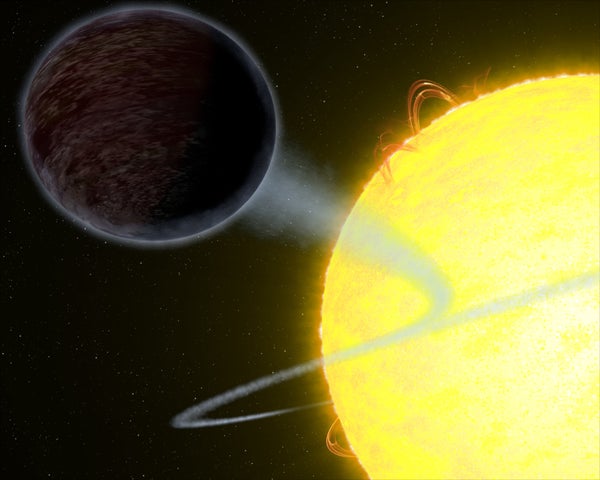

Exoplanets come in pretty much all colors, including pitch black.
The huge, blistering-hot alien world WASP-12b has a reflectance, or albedo, of just 0.064 at most, a new study reports.
"This is an extremely low value, making the planet darker than fresh asphalt!" lead author Taylor Bell, a master’s student in astronomy at McGill University in Montreal, said in a statement. [Gallery: The Strangest Alien Planets]
On supporting science journalism
If you're enjoying this article, consider supporting our award-winning journalism by subscribing. By purchasing a subscription you are helping to ensure the future of impactful stories about the discoveries and ideas shaping our world today.
For perspective, the moon's albedo on the same scale is 0.12, and Earth's is 0.37. The icy Saturn satellite Enceladus, the most reflective object in our solar system, clocks in at 1.4, study team members said. (These numbers are the "geometric albedo" of these objects. Another commonly used albedo scale, the Bond scale, goes from 0 to 1.)
WASP-12b lies about 1,400 light-years from Earth. The exoplanet is about twice the size of Jupiter and completes one lap around its star every 1.1 Earth days.
This super-close orbit has made the planet a bizarre and hellish world. The powerful gravitational tug of its parent star has pulled WASP-12b into an egg shape, and temperatures on the planet's dayside reach about 4,700 degrees Fahrenheit (2,600 degrees Celsius), study team members said. (Close-orbiting planets like WASP-12b tend to be tidally locked, always showing the same face to their star, just as the moon always shows its "near side" to Earth.)
WASP-12b has been studied extensively since its 2008 discovery. But Bell and his colleagues took another look in October 2016, investigating the "hot Jupiter" with the Space Telescope Imaging Spectrograph instrument aboard NASA's Hubble Space Telescope.
The low albedo came as a surprise, Bell said.
"There are other hot Jupiters that have been found to be remarkably black, but they are much cooler than WASP-12b," he said in the same statement. "For those planets, it is suggested that things like clouds and alkali metals are the reason for the absorption of light, but those don't work for WASP-12b because it is so incredibly hot."
It's so hot, in fact, that molecular hydrogen—the familiar H2—gets broken apart into atomic hydrogen in WASP-12b's skies. The team's work suggests that the planet's atmosphere is mostly atomic hydrogen and helium, and that this composition leads to the pitch-black profile.
WASP-12b is just the second exoplanet to have its albedo measured spectrally in this manner. The other—a fellow hot Jupiter, HD 189733b—appears to be deep blue.
"The fact that the first two exoplanets with measured spectral albedo exhibit significant differences demonstrates the importance of these types of spectral observations and highlights the great diversity among hot Jupiters," Bell said.
Though WASP-12b reflects virtually no light, it does emit some: The planet is so hot that it glows red like molten metal, researchers said.
EDITOR'S RECOMMENDATIONS
Copyright 2017 SPACE.com, a Purch company. All rights reserved. This material may not be published, broadcast, rewritten or redistributed.