
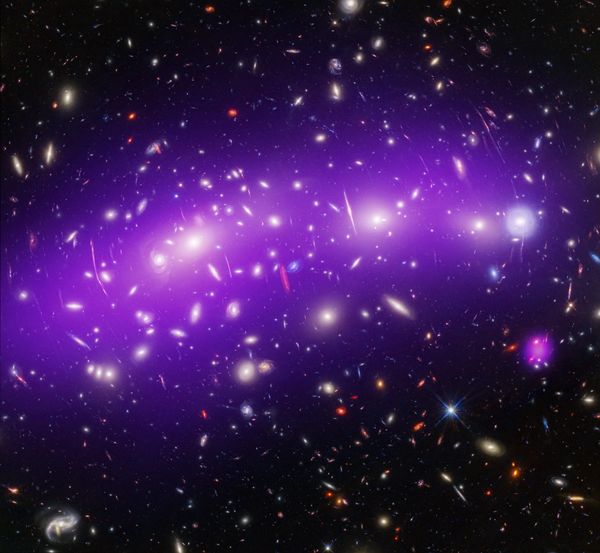
In a galaxy far, far away, strange objects beam radiation out into space. For years, these weird bodies have been hiding in plain sight—but now new observations reveal they may be key to understanding the lives and deaths of galaxies.
For decades, NASA’s Chandra X-ray Observatory has been picking up the signal of these objects, but scientists had largely ignored the data. The radiation the objects emit is relatively low-energy compared with that of most stars, making it easy to dismiss as noise.
“[Scientists] didn’t even know the objects were there,” says Jimmy Irwin, a professor at the University of Alabama and a co-author of a new paper published in Nature Astronomy that describes the odd objects. “They ignored the very, very lowest-energy channels because they thought they were unimportant.”
On supporting science journalism
If you're enjoying this article, consider supporting our award-winning journalism by subscribing. By purchasing a subscription you are helping to ensure the future of impactful stories about the discoveries and ideas shaping our world today.
Irwin and his colleagues, Ph.D. candidate Mustafa Muhibullah and Center for Astrophysics | Harvard & Smithsonian lecturer Rosanne Di Stefano, didn’t anticipate that they would find anything of note when they decided to go through the overlooked data just in case. Irwin compares the process to diving for treasure: you might find a long-lost gem, but you are far more likely to find a bunch of garbage.
The three scoured data collected by the Chandra space telescope between 1999 and 2017 and painstakingly filtered out any random artifacts and other junk. They were left with the signatures of emissions of low-energy x-rays coming from what they call “hypersoft x-ray sources,” a new type of celestial object.
But what exactly these objects are is a bit of a mystery because all that’s known about them is roughly how bright and hot they are.
“They must be compact objects that are the remnants of stars,” Di Stefano says, “either black holes, neutron stars or white dwarfs, that are ripping material from the companion. And as the material falls, it emits at x-ray wavelengths.”
They could also be a mixture of all of the above, Irwin says.
“They’re probably a heterogeneous mix of different types of objects,” he says. “A hypersoft source isn’t necessarily a type of object but a representation of what kind of energy is coming out.”
Whatever they are, the researchers believe they’re likely also emitting radiation in the more energetic extreme ultraviolet (EUV) range. Unfortunately, seeing objects in that range from Earth is difficult, if not impossible, because hydrogen gas and other stuff that lies in the space between star systems absorb most of those rays. As a result, most of these objects will likely remain hidden from view for all time, but there could be a countless number of them out there. Just a handful will ever be in places that allow them to be seen from our planet.
“If we had a telescope that was sensitive to EUV and we didn’t have the fog, these sources would be booming bright in these galaxies, and they would not have been missed,” Irwin says.
“The sources that we see, each one represents many additional sources within the galaxy that we cannot see because the light never makes it out of the host galaxy,” Di Stefano adds.
Even so, the few that are detectable could offer insight into how different celestial objects—from black holes to galaxies—form. The radiation from supermassive black holes at the center of galaxies, called active galactic nuclei, are generally credited with helping to ionize gas that later forms stars. Some galaxies lack these black holes but still have the ionized gas, and hypersoft emitters could help explain why.
“We’re seeing the tip of the iceberg,” Di Stefano says.