
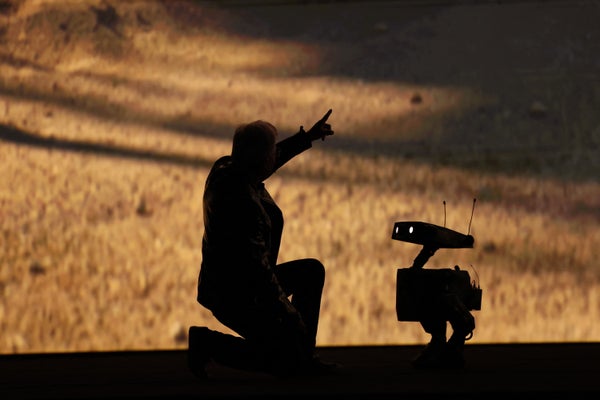
LAS VEGAS—At the back of a conference hall at the Mandalay Bay resort, a humanoid robot twitched through a preprogrammed wave for a crowd of cell phone cameras—a classic scene of high spectacle and unclear utility at CES. That’s what this trade show, held every January, does best: it turns prototypes into performances that double as technological predictions. While much of what appears here won’t ever emerge in the real world in a meaningful way, the ideas often do. And at this year’s show, one theme is hard to miss: artificial intelligence is on the move.
Physical AI—the use of automated machines that lift, drive, carry and operate in the same spaces humans do—is everywhere at CES, and the people making it have seemed eager to puncture its mythology. For years, the public-facing story of robotics has been viral athleticism: robot marathons, kickboxing videos. Now even the people who built those humanoids are treating them as a distraction. “We were doing ‘YouTube-video parkour’ 10 years ago,” said Robert Playter, CEO of robotics company Boston Dynamics, at a CES panel on AI in the physical world. “The hard stuff is useful work.” In other words: less spectacle, more operation in fields such as mining, construction and logistics, where the work is repetitive and expensive enough to justify the high costs of automation.
This step toward pragmatism confronts technology companies with a different barrier: trust. In the simpler times of 2022, when ChatGPT was novel, and AI as we know it lived mainly in chat windows, a hallucination was an annoyance. In a driverless car, it’s a different story. “Hallucination in motion can be disastrous,” said Jyoti Shah of data processing company ADP at a panel on AI in the physical world.
On supporting science journalism
If you're enjoying this article, consider supporting our award-winning journalism by subscribing. By purchasing a subscription you are helping to ensure the future of impactful stories about the discoveries and ideas shaping our world today.
Mikell Taylor, director of robotics strategy at General Motors, recounted hearing that a Zoox robotaxi recently stopped at a Las Vegas crosswalk and wouldn’t budge, leaving pedestrians confused and guessing. While not catastrophic, the anecdote suggested the urgency of the matter. Physical AI doesn’t just need better sensors; it needs to be legible, with cues easy enough for humans to read. Trust requires robots to be “transparent in their thinking and transparent in their motions,” said Carolina Parada of Google DeepMind, “so people know what to expect.”
The need for ever better real-time intelligence highlights a less glamorous theme of this year’s CES: computing power. On the hardware side, chip manufacturers characterized an industry that has been running up against physical limitations. Shankar Krishnamoorthy of electronic design automation company Synopsys said the traditional pace of chip development can’t keep up with what modern models demand. “Customers demand monster chips,” he said, “so we must accelerate innovation cycles by several [times].”
Then there’s the bill. AI that’s running everywhere, all the time will require massive infrastructure that still doesn’t exist. The scale and speed of today’s AI build-out is already driving up energy consumption and costs, and no amount of chip efficiency can compensate. It’s a constraint that nobody at CES came here to trumpet yet one that low-key governs everything else.
By the end of the day, plenty of the AI talk at CES has felt like a familiar story. “I think innovation is happening—it’s just being overhyped,” one conference attendee told me. “In a lot of ways, it echoes the IoT [Internet of Things] wave from 2010.” That is to say, some of the hype is real, and only time will tell what sticks. The question at CES this year is whether physical AI becomes another overused label—or whether it becomes a part of our everyday lives. If it does, that robot at Mandalay Bay will eventually have to do more than just wave.