
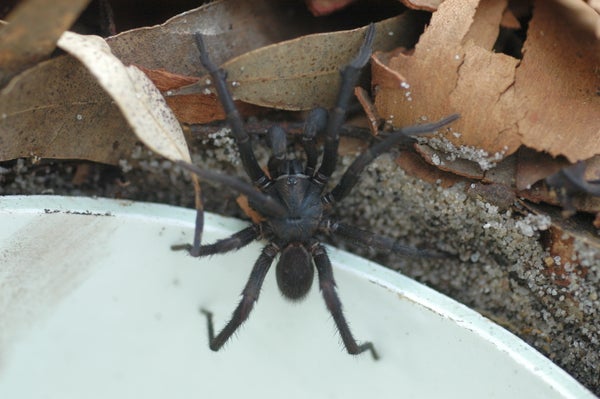
An Australian zookeeper on Tuesday urged people to catch and donate deadly funnel-web spiders, to help replenish stocks of antidote running low after a spate of spider bites.
The Australian Reptile Park, the country's sole supplier of funnel-web venom to antidote producers since 1981, relies on the public to hand in spiders that are milked for the venom used to produce an antidote.
The anti-venom program was now at risk after too few spiders were donated last year and a recent heatwave encouraged more spider activity and bites, the park's general manager, Tim Faulkner, said on Tuesday.
On supporting science journalism
If you're enjoying this article, consider supporting our award-winning journalism by subscribing. By purchasing a subscription you are helping to ensure the future of impactful stories about the discoveries and ideas shaping our world today.
"We rely on community support to keep this program alive," Faulkner said in a telephone interview.
"We have tried to catch enough spiders ourselves and we just can't."
Funnel-web spiders live throughout southeastern Australia, but the only known killer is the Sydney funnel-web spider, found in the Sydney region and as far north as Newcastle and south to Illawarra, the park says on its website.
"The large fangs and acidic venom make the bite very painful," it said, noting that a major bite can cause death within an hour if left untreated.
After milking the spiders, the park delivers the venom to a division of the blood plasma and vaccine maker CSL Ltd, which converts it into the life-saving antidote.
Australia has had two funnel-web spider attacks in two weeks, media have said, one of them involving a woman bitten by a spider while she was asleep.
Despite the terrifying reputation of Australian wildlife, nobody has died from the bite of a funnel-web spider since the anti-venom program began in 1981.
Catching venomous spiders is safe, as long precautions are followed, Faulkner said.
"With an appropriate jar and a wooden spoon, you can flick the spider into the jar so easily," he said.
"We've been doing this for 35 years and no one's been hurt." (Reporting by Claudia Farhart; Editing by Byron Kaye and Clarence Fernandez)