New Issue: Orbital Catastrophe Ahead? Read Now

Australian Bees Were Seen Foraging at Twilight for First Time

Bee morphological features can predict their nighttime feeding behaviors

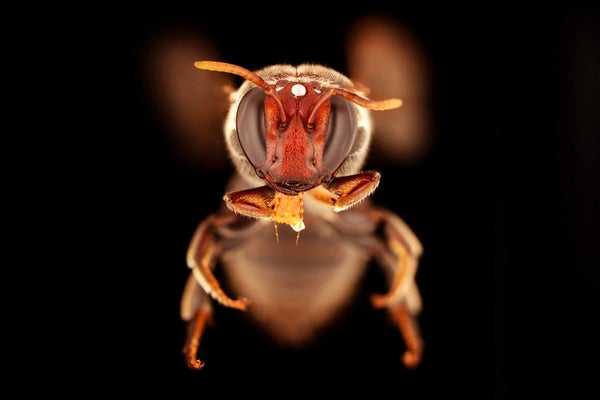
Bee species Merglossa gemmata, one of four now known to forage after sunset in Australia.

Bee species Merglossa gemmata, one of four now known to forage after sunset in Australia. Researchers spotted the mostly black bee on the blossoms of a weeping paperbark plant.

Join Our Community of Science Lovers!

Locking eyes with a bee is an opportunity offered only by photography. And while this close-up is strangely humanizing (who knew tilted antennae could look like a raised eyebrow?), it has a purpose, too. Scientists can determine whether a bee sees well in the dark by examining the insect’s portrait.

Last year a team of Adelaide, Australia–based researchers identified the first known Australian bees that collect nectar and pollen at twilight. The scientists witnessed the species pictured here and three others foragingafter sunset. When this species and two of the same genus were seen, the light was so low, “the host plant could only be perceived as a silhouette,” they wrote in a paper about their finding.

When the team captured the bees and brought them back to the lab, it found that photography could identify eye characteristics that were crucial for night vision. For example, the researchers examined the insects’ eye-to-head size ratios and found they had more face space dedicated to sight, which seemed likely to make them see better in low-light conditions. Similar photo shoots with other Australian bees could identify more yet unknown nighttime gatherers—information that could be important for protecting ecosystems as they operate through the night.


On supporting science journalism

If you're enjoying this article, consider supporting our award-winning journalism by subscribing. By purchasing a subscription you are helping to ensure the future of impactful stories about the discoveries and ideas shaping our world today.


Science in Images

Subscribe to Support Independent Journalism

Great science journalism requires human expertise, time, effort and creativity. And it costs money. That’s why I and the journalists here at Scientific American hope you’ll join our community.

When you subscribe, you are supporting staff and freelance journalists who are passionate about telling science stories that are true, important and compelling. Our editors and reporters are often experts in their fields, which means they understand the nuances of big discoveries and can untangle the breakthroughs from the hype. With a subscription, you are also supporting rigorous fact-checking to ensure the words we publish are precise and accurate. And you’re supporting original illustrations, graphics and photos that bring you closer to an advanced laboratory, an ice sheet in Antarctica or a space mission in orbit. You’re helping us craft other types of high-quality journalism as well: Our newsletters are carefully written, edited and curated by staffers you have or will come to know and love. Our Science Quickly podcast is based on original reporting, collaboration with editors and scientists and exacting production.

Subscriptions keep this engine running so we can continue to deliver thoughtful, rigorous and independent science journalism to you. In an era of viral misinformation, this work is crucial. If you value what we do, I hope you’ll consider joining us as a subscriber

Thank you,

Jeanna Bryner, Editor in Chief, Scientific American

Subscribe