
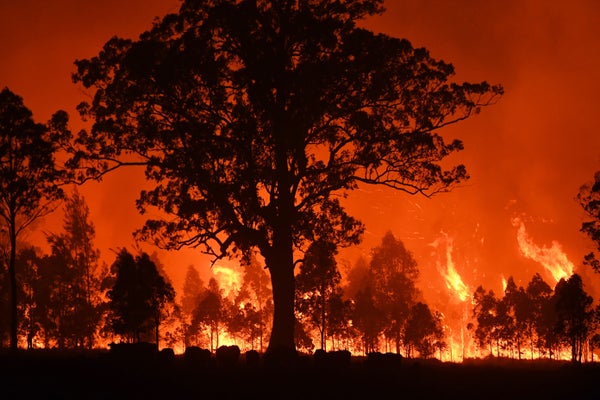
The extreme bush fires that blazed across southeastern Australia in late 2019 and early 2020 released 715 million tonnes of carbon dioxide into the air—more than double the emissions previously estimated from satellite data, according to an analysis published today in Nature.
“That is a stupendous amount,” says David Bowman, a fire ecologist at the University of Tasmania in Hobart, who adds that scientists might have to rethink the impact on global climate of extreme blazes, which have now raged not just across Australia, but across the western United States and Siberia. “Fire is a really big deal now.”
It’s not all bad news, however. Another paper in Nature reports that much of this plume of carbon might have been indirectly sucked up by a gigantic phytoplankton bloom in the Southern Ocean.
On supporting science journalism
If you're enjoying this article, consider supporting our award-winning journalism by subscribing. By purchasing a subscription you are helping to ensure the future of impactful stories about the discoveries and ideas shaping our world today.
Worst fires on record
The unprecedented fires burnt across as much as 74,000 square kilometres of mostly eucalyptus, or gum, forest in southeast Australia—an area larger than Sri Lanka.
Previous estimates from global databases of wildfire emissions based on satellite data suggested that the fires released about 275 million tonnes of carbon dioxide during their zenith, between November 2019 and January 2020.
But the new analysis indicates that this figure was a gross underestimate, says Ivar van der Velde, lead author of the first paper. “These models often lack the spatio-temporal detail to explain the full impact these fires have,” says van der Velde, an environmental scientist at the SRON Netherlands Institute for Space Research, in Utrecht, and at the Free University of Amsterdam.
He and his team set out to get a better estimate, based on more-granular data from the tropospheric monitoring instrument TROPOMI on the European Space Agency’s Sentinel-5 Precursor satellite.
TROPOMI takes daily snapshots of carbon monoxide levels in the atmospheric column beneath it. The researchers used this data to calculate a more accurate estimate of the carbon monoxide emissions from the bush fires, which they used as a proxy for calculating carbon dioxide emissions.
Their final figure—715 million tonnes—is nearly 80 times the typical amount of carbon dioxide emitted from fires in southeast Australia during the three peak months of the summer bush-fire season.
Bowman says the figure is similar to what his team calculated from the area of forests burnt, but much higher than figures based on previous satellite measurements of emissions.
The key question is how these forests will recover, says Cristina Santín, a wildfire researcher at the Spanish National Research Council in Asturias. Wildfires have long been considered net-zero-carbon events, because the emissions they release are recaptured when the vegetation regrows—but an increase in the frequency and intensity of fires in Australia could mean that ecosystems never fully bounce back. If these fires “threaten the recovery of the ecosystem, then we really need to worry”, she says.
Reason to hope
The second paper, also published today, could give researchers reason to hope, however. It suggests that the emissions generated by the bush-fire crisis were nearly offset by gigantic phytoplankton blooms in the Southern Ocean, recorded over the summer of 2019–20.
The findings demonstrate how wildfires can directly influence ocean processes, says study co-author Richard Matear, a climate scientist based in Hobart with the Australian government’s Commonwealth Scientific and Industrial Research Organisation. “The systems are connected.”
He and his colleagues found that, during the fires, vast black plumes of smoke, rich in nutrients, were swept thousands of kilometres away over the ocean. Within days, these aerosols had infused the waters with much-needed iron, nourishing phytoplankton, which sucked up carbon equivalent to as much as 95% of the emissions from the fires.
The ocean seems to achieve “an amazing sleight of hand—like a magician”, says Bowman. But he and other researchers say that more work needs to be done to understand where the carbon taken up by the plankton eventually goes, and whether it makes it back out into the atmosphere.
Both studies reveal surprising findings showing that “we don’t understand fires as much as we really need to”, says Santín—something she says we need to get a better handle on, because “fires are going to be increasingly important in the carbon cycle”.
This article is reproduced with permission and was first published on September 15 2021.