
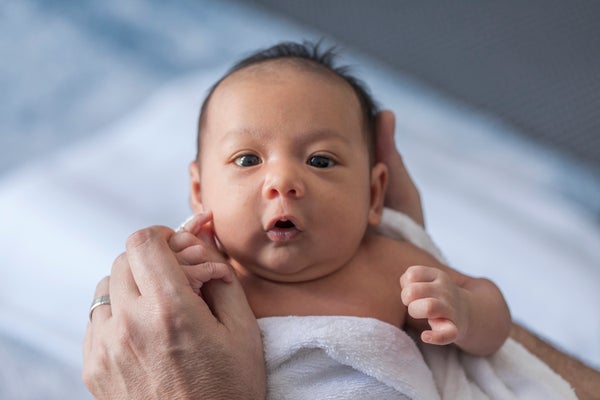
Babies start processing language before they are born, a new study suggests. A research team in Montreal has found that newborns who had heard short stories in foreign languages while in the womb process those languages similarly to their native tongue.
The study, published in August in Nature Communications Biology, is the first to use brain imaging to show what neuroscientists and psychologists had long suspected. Previous research had shown that fetuses and newborns can recognize familiar voices and rhythms and even that they prefer their native language soon after birth. But these findings come mostly from behavioral cues—sucking patterns, head turns or heart rate changes—rather than direct evidence from the brain.
“We cannot say babies ‘learn’ a language prenatally,” says Anne Gallagher, a neuropsychologist at the University of Montreal and senior author of the study. What we can say, she adds, is that neonates develop familiarity with one or more languages during gestation, which shapes their brain networks at birth.
On supporting science journalism
If you're enjoying this article, consider supporting our award-winning journalism by subscribing. By purchasing a subscription you are helping to ensure the future of impactful stories about the discoveries and ideas shaping our world today.
The research team recruited 60 people for the experiment, all of them about 35 weeks into their pregnancy. Of those, 39 exposed their fetuses to 10 minutes of prerecorded stories in French (their native language) and another 10 minutes of the same stories in either Hebrew or German at least once every other day until birth. These languages were chosen because their acoustic and phonological properties are very distinctfrom French and from each other, explains co-lead author Andréanne René, a Ph.D. candidate in clinical neuropsychology at the University of Montreal. The other 21 participants were part of the control group; their fetuses were exposed to French in their natural environments, with no special input.
Between the first 10 hours and three days after birth, the team observed how the newborns’ brains reacted to German, Hebrew and French by using functional near-infrared spectroscopy (fNIRS), a noninvasive imaging technique that measures changes in blood oxygenation in the brain.
All babies in the cohort had increased activity in the left temporal lobe, the brain’s language processing center, when they heard spoken French. But only those exposed to Hebrew or German before birth showed similar brain activation when listening to those languages. Newborns who had not heard the Hebrew or German stories before birth showed activation in brain regions for processing sounds in general and less activation in language-processing regions.
The study supports the idea that the newborn brain is not a “blank slate,” says Ana Carolina Coan, a pediatric neurology expert and member of the Brazilian Academy of Neurology. Instead the gestational environment starts shaping fetuses’ brain processing even before birth.
It isn’t clear how much in utero exposure to a given tongue is needed for newborns’ brains to process it as language. Some previous research into the effects of the auditory environment on fetuses used hours-long exposure; other studies used a duration of as little as 15 minutes. Gallagher was concerned that the new study’s exposure time wouldn’t be enough to note any response, but asking for more than that might have been burdensome to the participants. This made the study’s clear results a welcome surprise, she says.
“The study doesn’t suggest mothers should expose their unborn babies to foreign languages to be smarter or multilingual later,” says Coan, who did not take part in the research. But studying how language exposure in utero affects a child’s speech development will be important for understanding speech disorders, which affect around 5 to 10 percent of children in the U.S. “For clinicians, this adds evidence that language development begins much earlier than birth, which matters for how we detect and treat delays,” she says.