
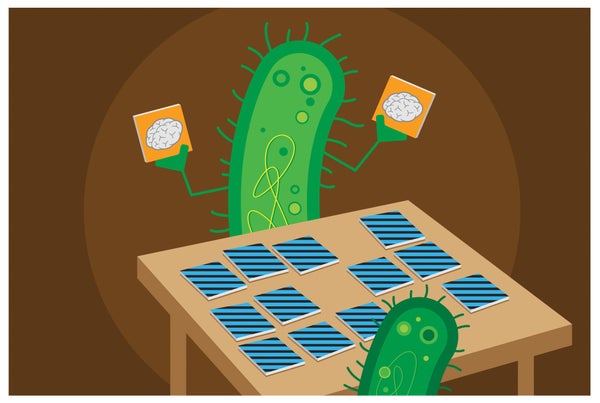
Even organisms without brains can remember their past: Scientists found that Escherichia coli bacteria form their own kind of memories of exposure to nutrients. They pass these memories down to future generations, which can help them evade antibiotics, the research team reported in the Proceedings of the National Academy of Sciences USA.
“We typically think of microbes as single-celled organisms [that each] do their own thing,” says Dartmouth College microbiologist George O'Toole, who studies bacterial structures called biofilms. In reality, bacteria frequently survive by working together. Much like honeybees relocating their hive, colonies of bacteria in search of permanent homes will often travel as collective units called swarms.
These swarms can better withstand antibiotic exposure because of their high cell density, making them of particular interest to microbiologists such as Souvik Bhattacharyya of the University of Texas at Austin. He was studying swarming behavior in E. coli when he observed what he calls “weird colony patterns” he had never seen before. By isolating individual bacteria, he and his colleagues discovered that the cells were behaving differently based on their past experience. Bacteria cells in colonies that had previously swarmed were more prone to swarm again than those that hadn't, and their offspring followed suit for at least four generations—about two hours.
On supporting science journalism
If you're enjoying this article, consider supporting our award-winning journalism by subscribing. By purchasing a subscription you are helping to ensure the future of impactful stories about the discoveries and ideas shaping our world today.
By tweaking the E. coli genome, the scientists found that underlying this ability were two genes that together control the uptake and regulation of iron. Cells with low levels of this important bacterial nutrient seemed predisposed to form mobile swarms. The researchers suspect these swarms could then seek out new locations with ideal iron levels, Bhattacharyya says.
Past research has shown that some bacteria can remember and pass to their offspring details of their physical environment, such as the existence of a stable surface, O'Toole says, but this study suggests that bacteria can also remember nutrients' presence. Bacteria, some of which reproduce multiple times per hour, use these details to determine the longer-term suitability of a location and may even settle together in biofilms, which are more permanent.
Microbes other than E. coli probably remember iron exposure, too, O'Toole says. “I would be really shocked if [these results] didn't hold up in other bugs as well.” He hopes that future research examines on a cellular level how bacteria translate iron detection into different behaviors.
Because bacteria are tougher to kill when they form larger structures, understanding why they do so might eventually lead to new approaches for addressing stubborn infections. This research provides an opportunity to develop new infection-fighting treatments, O'Toole says—especially crucial as antibiotics become less and less effective at killing these microbes.