
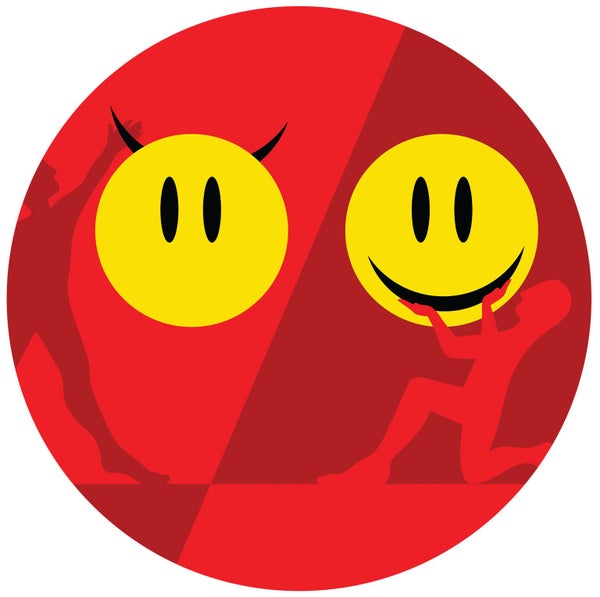
Common wisdom holds that negative first impressions are hard to shake—and some research backs this up. But such studies often unfairly compare impressions based on immoral deeds that are extreme and relatively rare (such as selling drugs to kids) with impressions based on kindnesses that are more common (such as sharing an umbrella). A new set of studies involving precisely balanced behaviors finds that people are more willing to change their mind about individuals who initially come off as selfish than about those they deem selfless.
In three of the experiments, 336 laboratory and online participants read about two people who each made a series of 50 decisions regarding how many electric shocks to give someone in exchange for money. One fictional subject required more money per shock than the average person did to inflict pain on others. The other’s price-per-shock threshold was comparably lower than the average person’s. Study participants read about each subject’s decisions one at a time. Before seeing each decision, they predicted what it would be. After every three decisions the fictional subject made, participants rated the individual on a scale from “nasty” to “nice,” then specified their confidence in the rating.
As expected, participants rated the person who gave shocks for a lower price as nastier than the higher-price shocker. But they expressed less confidence in the “nasty” ratings, and their predictions of how many shocks that person would give fluctuated more. In other words, their beliefs about the “bad” subject were more changeable. “A well-designed brain system would not write someone off completely at the first sign of trouble,” says Molly Crockett, a psychologist at Yale University, who co-authored a paper about the new set of studies, published in October in Nature Human Behaviour. An open mind helps people forgive and form bonds, Crockett adds.
On supporting science journalism
If you're enjoying this article, consider supporting our award-winning journalism by subscribing. By purchasing a subscription you are helping to ensure the future of impactful stories about the discoveries and ideas shaping our world today.
The test scenarios are a far cry from real-world interactions. Still, the experiment offers “a really elegant paradigm that drills down on a question that’s so central to our everyday human life,” says Peter Mende-Siedlecki, a psychologist at the University of Delaware, who was not involved in the study. Crockett suspects the findings about social impressions reflect a general mental process of absorbing more information in threatening situations. She describes the resultant social tendency as a double-edged sword: “It’s very good for conflict resolution—but at the same time it could trap you in a bad relationship.”