
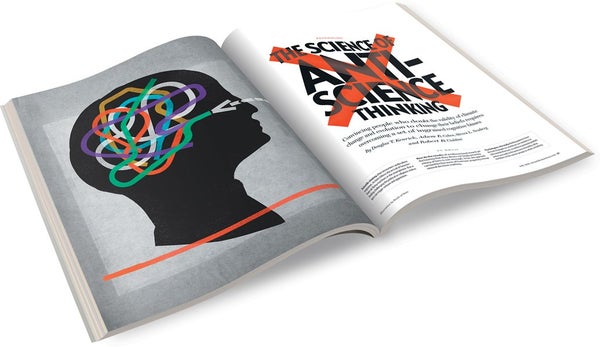
We may think we have an ability to be fair and impartial—to make decisions and judgments based on the weight of evidence. But unfortunately, we humans are all irrational. When faced with an overwhelming amount of information, our brains take shortcuts; instead of taking time to analyze, we may accept a group decision or a trusted expert. Worse, even when we have time to consider our decisions, we prefer to interpret the evidence to fit our preexisting beliefs, called confirmation bias. And even if we can clear the first two hurdles, we may fall prey to social motivations. We may accept beliefs that seem more likely to improve personal status, or that conform to the views of a political party, or that even help us find a partner.
This month, we take a look at “The Science of Antiscience Thinking,” co-authored by researchers Douglas T. Kenrick, Adam B. Cohen, Steven L. Neuberg and Robert B. Cialdini. What happens when our irrational tendencies encounter the process of science, which promises an unvarnished view of reality, based on testing and collected evidence—on facts? Perhaps unsurprisingly, we celebrate the fruits of research when the process yields something we value—a cure for a disease, say, or the latest smartphone. But what if we don't like what we hear? We reject it. Sadly for us, some problems, such as global climate change, mean that we can't dally forever. On the bright side, psychologists have developed strategies—such as a change of perspective—to help counteract our natural inclinations. It's a welcome dose of optimism for a sometimes puzzling world.
Speaking of confounding topics, how about the strange, probabilistic quantum-mechanical world versus our everyday “classical” world, where everything seems to be hard and fast? In this issue's cover story, “Crossing the Quantum Divide,” science journalist Tim Folger lays out upcoming efforts by physicists to explore where one realm passes into the other.
On supporting science journalism
If you're enjoying this article, consider supporting our award-winning journalism by subscribing. By purchasing a subscription you are helping to ensure the future of impactful stories about the discoveries and ideas shaping our world today.
How the body's cycles crossed the line from folk medicine into modern science is the topic of “The Clocks within Our Cells,” by science writer and essayist Veronique Greenwood. She describes an emerging field called chronomedicine, which is testing timed treatments of diseases such as cancer and rheumatoid arthritis. Someday personalized monitoring of circadian rhythms may support different treatment times for each of us.
As always, if you feel it's time to surmount the border between editors and readers, please do communicate with us about the stories in this issue. We welcome your responses.