
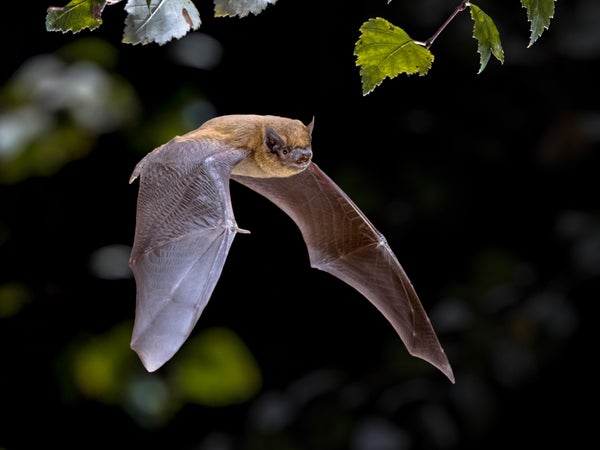
Bats are impressive navigators. Like so many mini submarines equipped with sonar, they deftly navigate dark forests and caves by listening for the echoes of their own calls. But how bats can tell which echo to follow while flitting around in a sea of overlapping and competing signals pinging off the myriad surfaces in their environments has been a mystery—until now.
In a new study published in Proceedings of the Royal Society B, researchers lay out evidence that bats find their way by listening to how their own movement changes sounds.
Imagine being at a party with hundreds or even thousands of people all talking at once; it’s difficult to make out a single speaker, explains Marc Holderied, a professor of sensory biology at the University of Bristol in England and an author of the study. That’s comparable to what a bat may be dealing with as the animal zooms around a dense forest—a chaotic environment that can make it hard to echolocate.
On supporting science journalism
If you're enjoying this article, consider supporting our award-winning journalism by subscribing. By purchasing a subscription you are helping to ensure the future of impactful stories about the discoveries and ideas shaping our world today.
To solve this problem, the animals appear to rely on Doppler shift, or how a sound’s pitch changes as a bat travels.
“As the bat is moving,” Holderied says, “this Doppler shift, in this complex echo of thousands of reflectors, carries information.”
How the team reached that conclusion is an impressive and strange tale. Holderied and his colleagues observed wild pipistrelle bats using a contraption that they dubbed the “bat accelerator.” The machine is basically an eight-meter tunnel of treadmills covered in plastic leaves—about 8,000 of them all stapled on by hand, explains Athia Haron, a medical engineering research associate at the University of Manchester in England and a study co-author.
The researchers theorized that if bats picked up on the Doppler effect, then the direction that the foliage treadmill was moving in would affect how fast the animals flew.
When the treadmill moved in the direction of the bats’ flight, the critters sped up. When the foliage appeared to come toward them, however, they slowed down. “We tricked them into thinking that their speed is different,” Holderied says.
The results suggest the bats take the Doppler effect into account as they fly and use it to control their speed.
Researchers already knew of some bat species that are so-called Doppler specialists, Holderied says, but pipistrelle bats aren’t among them. The new findings indicate that the Doppler effect is used by bats that aren’t Doppler specialists.
And the bizarre experiment could help engineers enhance navigation systems for drones or self-driving cars, Haron says—something she has already begun to explore. “If that pans out, that would benefit a lot of navigation systems that fail in these kinds of cluttered environments,” she says.