
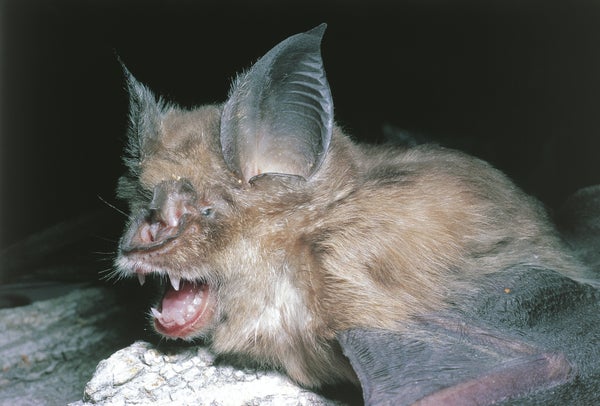
After a detective hunt across China, researchers chasing the origin of the deadly SARS virus have finally found their smoking gun. In a remote cave in Yunnan province, virologists have identified a single population of horseshoe bats that harbours virus strains with all the genetic building blocks of the one that jumped to humans in 2002, killing almost 800 people around the world.
The killer strain could easily have arisen from such a bat population, the researchers report in PLoS Pathogens on November 30. They warn that the ingredients are in place for a similar disease to emerge again.
In late 2002, cases of a mystery pneumonia-like illness began occurring in Guangdong province, southeastern China. The disease, dubbed severe acute respiratory syndrome (SARS), triggered a global emergency as it spread around the world in 2003, infecting thousands of people.
On supporting science journalism
If you're enjoying this article, consider supporting our award-winning journalism by subscribing. By purchasing a subscription you are helping to ensure the future of impactful stories about the discoveries and ideas shaping our world today.
Scientists identified the culprit as a strain of coronavirus and found genetically similar viruses in masked palm civets (Paguma larvata) sold in Guangdong’s animal markets. Later surveys revealed large numbers of SARS-related coronaviruses circulating in China’s horseshoe bats (Rhinolophus)—suggesting that the deadly strain probably originated in the bats, and later passed through civets before reaching humans. But crucial genes—for a protein that allows the virus to latch onto and infect cells—were different in the human and known bat versions of the virus, leaving room for doubt about this hypothesis.
Bat hunt
To clinch the case, a team led by Shi Zheng-Li and Cui Jie of the Wuhan Institute of Virology in China sampled thousands of horseshoe bats in locations across the country. “The most challenging work is to locate the caves, which usually are in remote areas,” says Cui. After finding a particular cave in Yunnan, southwestern China, in which the strains of coronavirus looked similar to human versions, the researchers spent five years monitoring the bats that lived there, collecting fresh guano and taking anal swabs.
They sequenced the genomes of 15 viral strains from the bats and found that, taken together, the strains contain all the genetic pieces that make up the human version. Although no single bat had the exact strain of SARS coronavirus that is found in humans, the analysis showed that the strains mix often. The human strain could have emerged from such mixing, says Kwok-Yung Yuen, a virologist at the University of Hong Kong who co-discovered the SARS virus: “The authors should be congratulated for confirming what has been suspected.”
But Changchun Tu, a virologist who directs the OIE Reference Laboratory for Rabies in Changchun, China, says the results are only “99%” persuasive. He would like to see scientists demonstrate in the lab that the human SARS strain can jump from bats to another animal, such as a civet. "If this could have been done, the evidence would be perfect,” he says.
Travel trouble
Another outstanding question is how a virus from bats in Yunnan could travel to animals and humans around 1,000 kilometres away in Guangdong, without causing any suspected cases in Yunnan itself. That “has puzzled me a long time”, says Tu.
Cui and Shi are searching for other bat populations that could have produced strains capable of infecting humans. The researchers have now isolated some 300 bat coronavirus sequences, most not yet published, with which they will continue to monitor the virus’s evolution.
And they warn that a deadly outbreak could emerge again: the cave where the elements of SARS were found is just 1 kilometre from the nearest village, and genetic mixing among the viral strains is fast. “The risk of spillover into people and emergence of a disease similar to SARS is possible,” the authors write in their paper.
Although many markets selling animals in China have already been closed or restricted following outbreaks of SARS and other infectious diseases, Yuen agrees that the latest results suggest the risk is still present. “It reinforces the notion that we should not disturb wildlife habitats and never put wild animals into markets,” says Yuen. Respecting nature, he argues, “is the way to stay away from the harm of emerging infections”.
This article is reproduced with permission and was first published on December 1, 2017.