
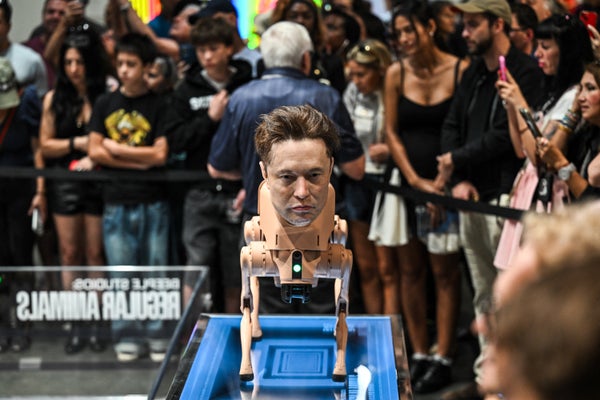
Imagine Elon Musk staring you down. Now imagine his head on a doglike robot as it looks at you, squats and poops out your image. This was part of an installation entitled Regular Animals at this year’s Art Basel Miami Beach art fair. Viewers stood outside a pen containing robot quadrupeds with the heads of tech billionaires, famous artists and Mike Winkelmann, aka Beeple—the creator behind all this. The vibe was equal parts showroom, petting zoo and black comedy.
The gag is crude, but the point is serious: Beeple is mocking the way tech power, and the data we unknowingly surrender, shapes what culture becomes.
“For now, we imagine ourselves the authors and operators of these systems,” Beeple wrote in his artist statement. “As robotics and AI advance toward forms of autonomy, the possibility emerges that these beings may one day claim their own interpretive authority.”
On supporting science journalism
If you're enjoying this article, consider supporting our award-winning journalism by subscribing. By purchasing a subscription you are helping to ensure the future of impactful stories about the discoveries and ideas shaping our world today.
Beeple, an American digital artist whose nonfungible token (NFT) artwork sold for $69 million at Christie’s in 2021, helped launch the art marketplace for such NFTs, digital items recorded on a blockchain to publicly show their ownership. Now he’s contemplating our AI future. “We’ll be viewing the world through the lens of robots and machines and math,” he said in an interview with Whitewall. “Certain people shape the way we view the world.”
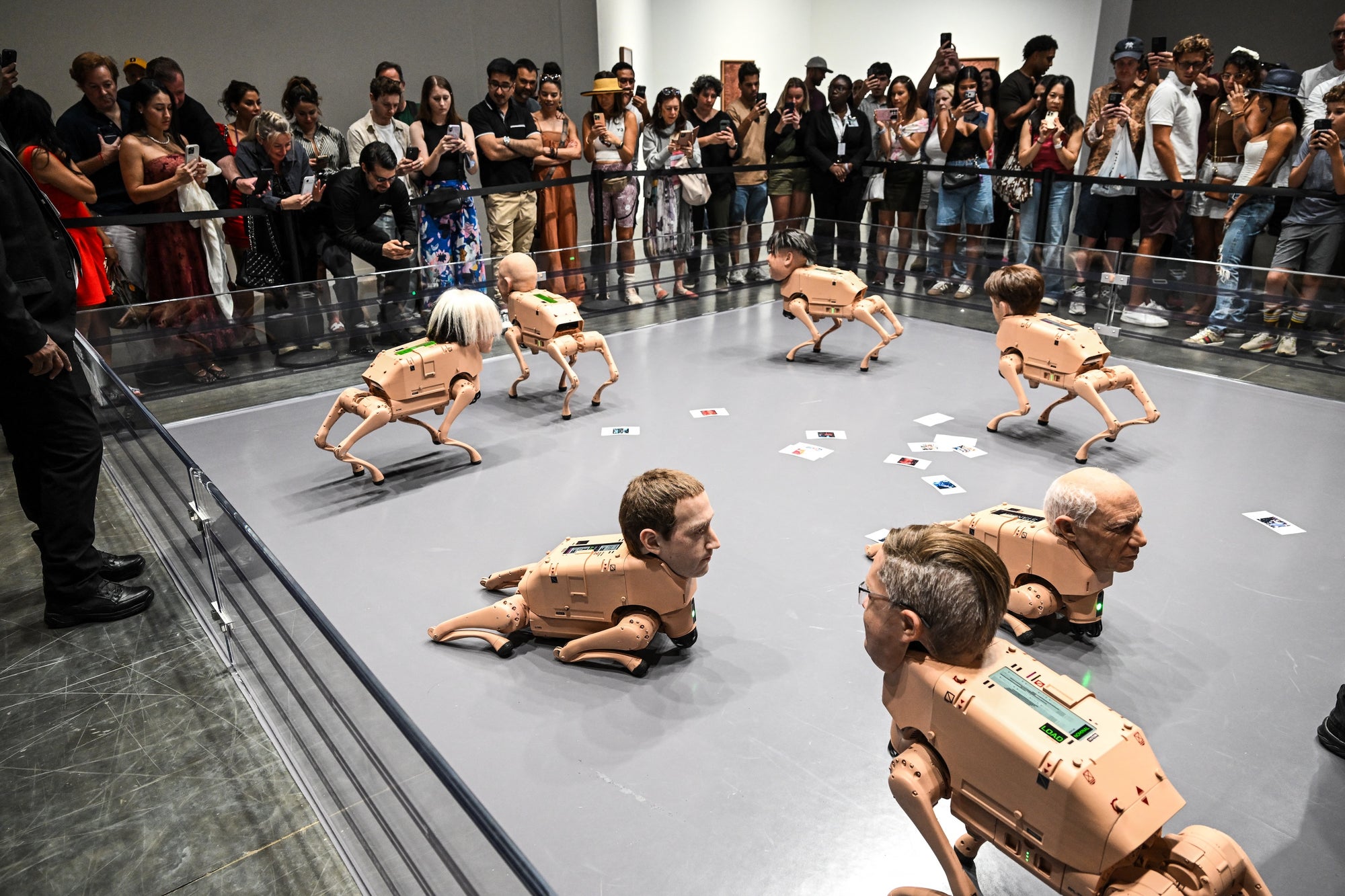
People look at the art installation Regular Animals by digital artist Mike Winkelmann, also known as Beeple, during Art Basel 2025 at Miami Beach Convention Center in Miami Beach, Florida, on December 7, 2025.
CHANDAN KHANNA/AFP via Getty Images
In Regular Animals, each robot had a camera that captured images of people; an internal computer applied AI-based styling, and a compact printer ejected four-by-six-inch “certificates” from the robots’ behind. When the Musk robot looked at the crowd, the AI converted what it saw to stark black-and-white linework with labeled parts, charts and flow diagrams—like a patent drawing explaining a human audience. A Zuckerberg robot’s droppings had a deep-blue “metaverse” vibe, with hologram people and grid floors. A robot with the head of the Spanish painter Pablo Picasso discharged prints with angular faces and bold colors. And a mechanical dog bearing the head of American pop artist Andy Warhol excreted images with halftone dots and a printed-media feel.
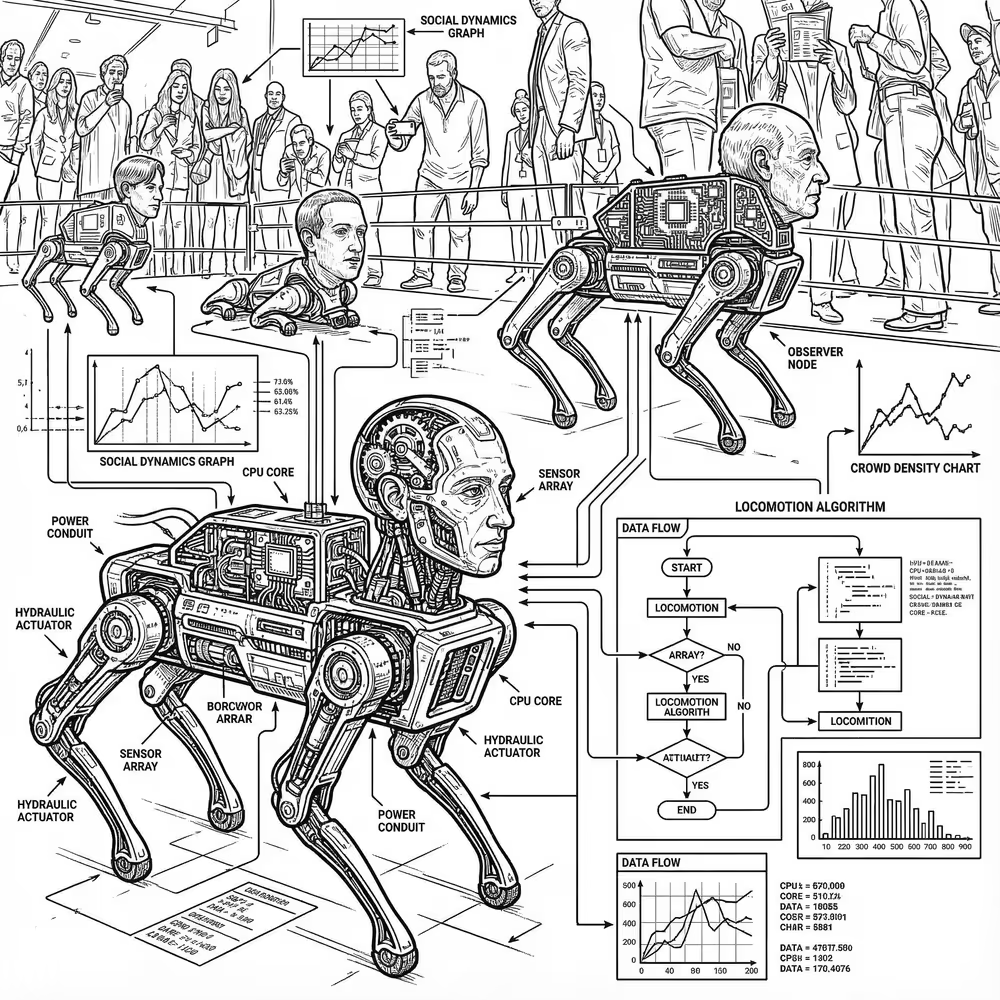
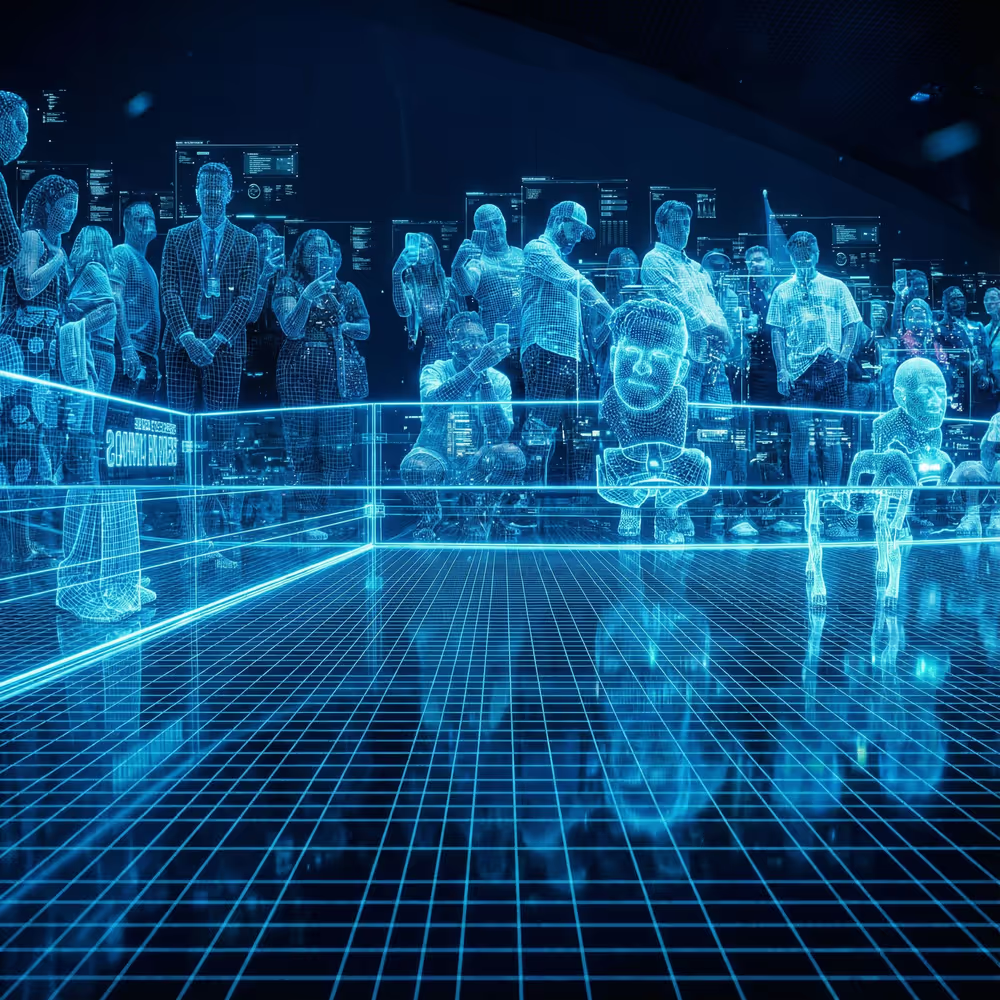
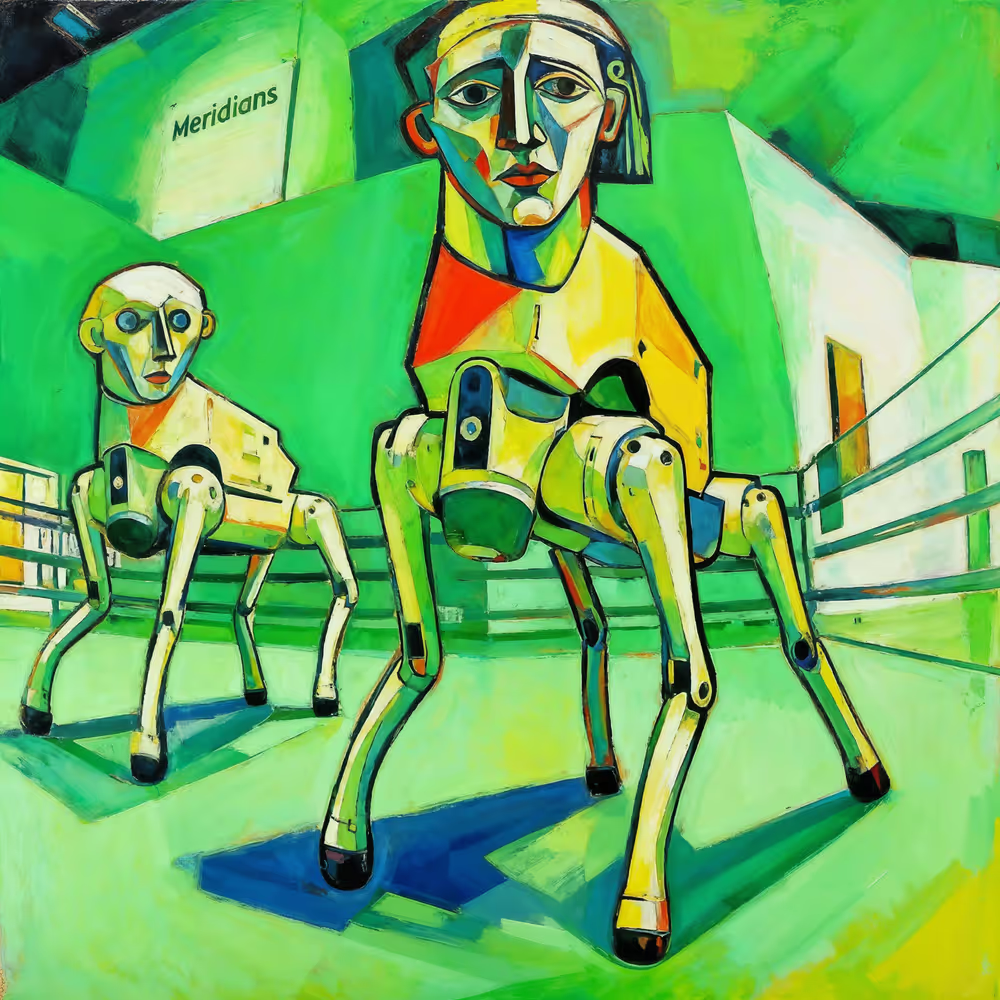
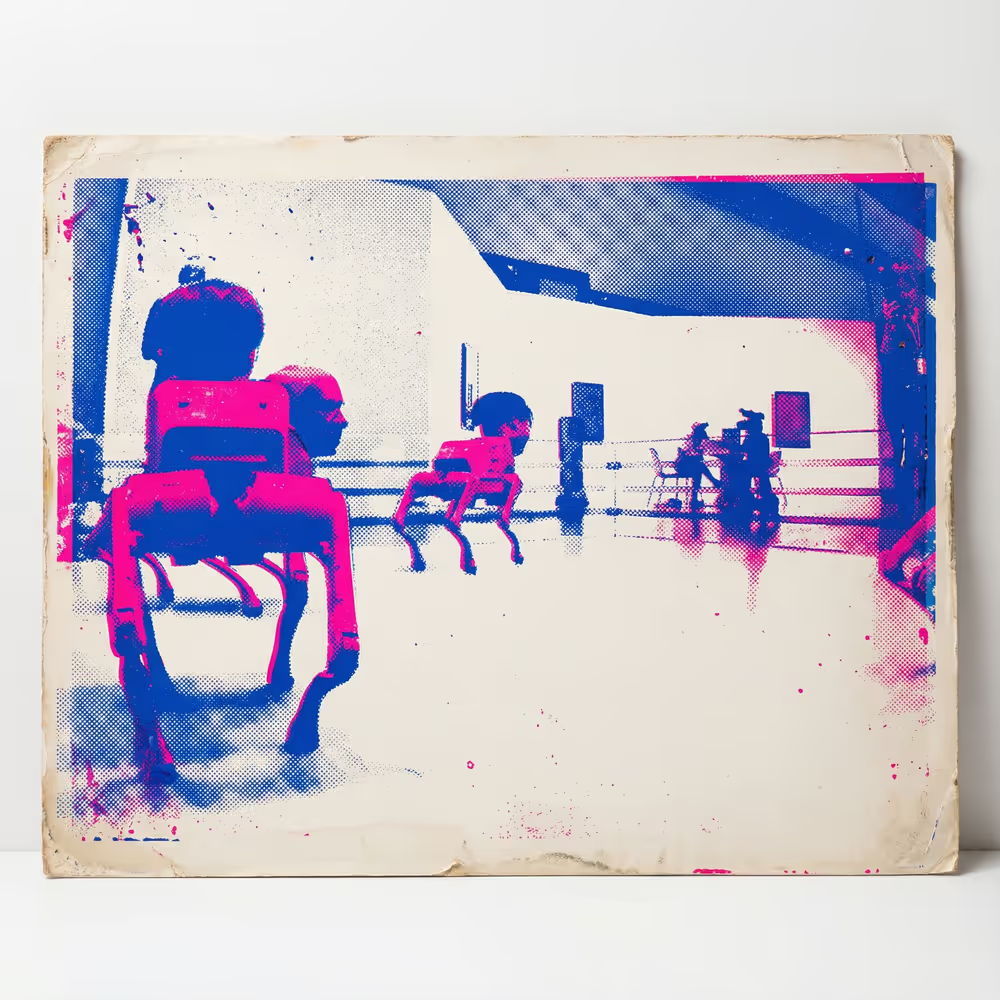
“Let’s recognize the reality that Mark Zuckerberg and Elon Musk have a massive amount of influence on what we see, and how we see the world,” Beeple told the Wall Street Journal. “They just wake up and they change this or that algorithm and boom: Our visual culture changes immediately, for better or worse.”
To create the exhibition, Beeple relied on the work of others. The hyperrealistic heads were the product of Hyperflesh, the company of mask maker Landon Meier. The metal and polymer robots were from Unitree, a Chinese robotics company. Each used lidar navigation, similar to the sensing systems in Waymo and other self-driving taxis, to map the surroundings and approach the viewers.
Though many of the robots sold for $100,000 each, not all art critics were charmed. Beeple has long lived inside the cryptocurrency economy he now satirizes—part of what makes the piece either self-aware or self-serving, depending on your read. In the online arts magazine Hyperallergic, senior editor Valentina Di Liscia derided the work, saying the installation’s real purpose was “to advance crypto wealth by making you, the viewer, an active participant in the ploy.”
The exhibition’s deeper insight may simply be the reminder that we’re all becoming AI training data. As robots get cheaper and more common, more machines will map rooms and capture images. Customer service bots, warehouse robots, delivery devices and security systems will collect data that, as Beeple’s statement reminds us, will become “part of the vast, ever-growing archive from which future intelligences will be shaped.” The joke lands because it’s already true: the more machines look at us, the more we’ll be absorbed into the immense archive from which future intelligences learn to generate culture—whether we consent or not.