
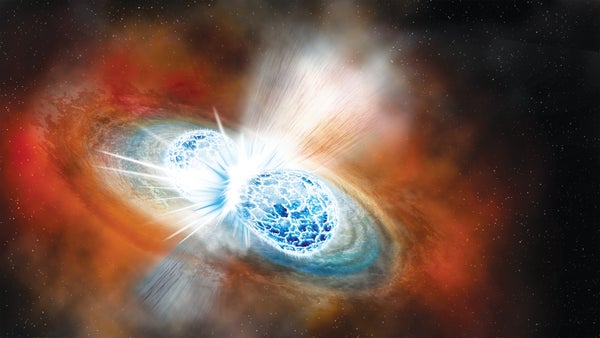
On the morning of August 17 last year, a new era of astronomy dawned with a flash in the sky. The burst of gamma rays, glimpsed by the Fermi Gamma-ray Space Telescope, came from the merger of two neutron stars (extremely dense objects formed when massive stars collapse and die) somewhere in the universe. But gamma rays weren't the only thing the merger produced. Within seconds of Fermi's detection, ripples in spacetime from the merger had echoed through two facilities—the U.S.-based LIGO and the Italy-based Virgo observatories—like rolling thunder after a lightning strike.
These ripples are known as gravitational waves, and detecting them is more like “hearing” than “seeing.” Based on the waves' arrival times and strength, astronomers pinpointed their source to a galaxy 130 million light-years from Earth. Next, thousands of scientists around the world mobilized to conduct a coordinated study of the merger's afterglow across the entire electromagnetic spectrum, the range of frequencies from gamma rays to visible light to radio waves.
The payoff was worth it. The observations revealed that the merger had produced vast quantities of elements heavier than iron, confirming a theory that colliding neutron stars are a primary cosmic source of gold and other precious metals. As more such mergers are detected and studied, the collective census could reveal much about the inner workings of neutron stars—city-sized stellar corpses so dense they are on the cusp of collapsing into black holes. Furthermore, by comparing a merger's brightness with the strength of its gravitational waves, astronomers can gauge its exact distance. This knowledge could allow them to probe the nature of dark energy, the mysterious force thought to be accelerating the universe's expansion.
On supporting science journalism
If you're enjoying this article, consider supporting our award-winning journalism by subscribing. By purchasing a subscription you are helping to ensure the future of impactful stories about the discoveries and ideas shaping our world today.

Astronomers using the Swope telescope at Las Campanas Observatory in Chile pinpointed the source of the neutron star merger on August 17, 2017. Credit: Yuri Beletsky
The scientific haul from the first observed neutron star merger, though impressive, could have been even greater. The IceCube observatory in Antarctica looked for ghostly particles called neutrinos from the collision but found none—most likely because these particles were emitted as a beam that missed Earth, according to IceCube's top scientist, Francis Halzen. If detecting light and gravitational waves from the merger was akin to seeing and hearing it, finding neutrinos would have been like tasting it, too.
Researchers call this coordinated approach “multimessenger” astronomy, in which the messengers can be electromagnetic radiation, gravitational waves or subatomic particles. Astronomers pioneered the method in 1987, when they saw light and tasted neutrinos from a supernova detonating in one of the Milky Way's small satellite galaxies. Yet only now can scientists turn an ear to gravitational waves as well, thanks to LIGO and Virgo. The multimessenger approach is in many respects the fulfillment of one of astronomers' wildest dreams—still, it will require wrangling a nightmarish deluge of data from disparate observatories.
“We need to rethink how we do this because we may soon see an event like this merger once per month or even per week,” says Vicky Kalogera, an astronomer at Northwestern University and a prominent member of the LIGO team. “This one took [over] people's lives. We all dropped everything, told our families and kids we wouldn't see them until the results were announced.” Mergers may begin to pop up so frequently, Kalogera says, that most will simply not be studied in such great detail.
Already IceCube has sparked another global multimessenger follow-up campaign—this time studying the origins of a high-energy neutrino detected on September 22, 2017. That effort tentatively traced the neutrino to a flaring debris disk orbiting a supermassive black hole in the center of a galaxy more than a billion light-years away. This discovery suggests, Halzen says, that such “active galactic nuclei” are the probable sources of most of the high-energy neutrinos and cosmic rays streaming through the universe. “We may be in the home stretch for revealing the origins of cosmic rays, which have been a mystery in astronomy for more than a century,” he says.
There are already several small telescopes dedicated to investigating alerts from LIGO, Virgo and IceCube. But their capabilities pale in comparison to the eagerly awaited Large Synoptic Survey Telescope (LSST), an observatory with an 8.4-meter-wide mirror set to begin a 10-year survey in 2022. Imaging the entire visible sky every few nights from its perch on a Chilean mountaintop, LSST's all-seeing eye could become crucial for probing the optical counterparts of future events heard by LIGO and Virgo—or tasted by IceCube. But “not if there are 10 of them every night—that would destroy our survey!” says LSST chief scientist Tony Tyson. Pinning down the electromagnetic source of any given gravitational wave or neutrino signal would require hours of telescope time and sifting through terabytes of raw data, Tyson explains.
Most astronomers agree that the promise of this field outweighs the challenges, however. “Very rarely do you establish this kind of new frontier in astronomy,” says Avi Loeb, an astrophysicist at Harvard University, who has worked extensively on multimessenger approaches. “It seems nature has been almost too kind to us.”