
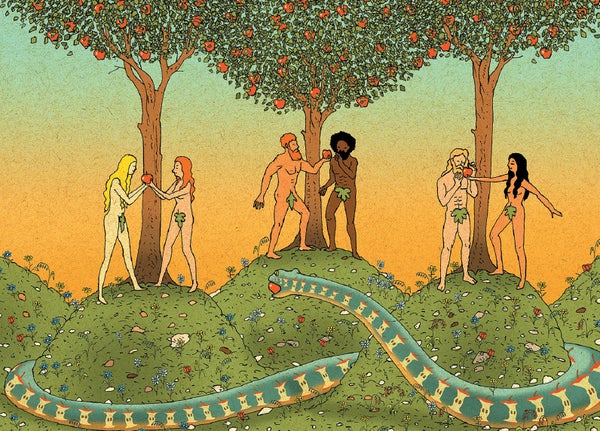
When did you choose to become straight?
Say what?
By demographic distribution (about 95 percent of the population identifies as heterosexual), the majority of you reading this column are straight. You no more chose this sexual orientation than gays or lesbians choose theirs. Yet a new study published in the fall issue of the nonpeer-reviewed journal The New Atlantis by Johns Hopkins University's Lawrence S. Mayer and Paul R. McHugh on “Sexuality and Gender” claims that “our scientific knowledge in this area remains unsettled,” that there is no “scientific evidence for the view that sexual orientation is a fixed and innate biological property,” and that no one is “born that way.” This sounds so 1990s, the last time the gender wars heated up. What's going on here?
On supporting science journalism
If you're enjoying this article, consider supporting our award-winning journalism by subscribing. By purchasing a subscription you are helping to ensure the future of impactful stories about the discoveries and ideas shaping our world today.
One clue comes from the journal's co-publisher, the Ethics and Public Policy Center (EPPC), “dedicated to applying the Judeo-Christian moral tradition to critical issues of public policy.” Already we're off the science page. EPPC scholars, its Web page continues, “have consistently sought to defend and promote our nation's founding principles—respect for the inherent dignity of the human person, individual freedom and responsibility, justice, the rule of law, and limited government.”
Shouldn't such principles apply to everyone regardless of whether or not their sexual orientation is biologically determined? Of course, and in most Western countries today they do. But in Judeo-Christian America, the argument goes like this: The Bible says that homosexuality is a sin (Leviticus 20:13). If sexual orientation has a strong biological component, then gays and lesbians can hardly be held morally culpable for their sinful ways. But if it's a choice, then they can be rehabilitated (through “conversion therapy”) and forgiven (“love the sinner, hate the sin” goes the popular trope). Evangelist Jimmy Swaggart articulated the logic this way: “While it is true that the seed of original sin carries with it every type of deviation, aberration, perversion, and wrongdoing, the homosexual cannot claim to have been born that way any more than the drunkard, gambler, killer, etc.”
While the authors of the New Atlantis article are not this crude and overtly bigoted in their conclusions, according to geneticist Dean Hamer, emeritus at the National Institutes of Health, “it is a selective and outdated collection of references and arguments aimed at confusing rather than clarifying our understanding of sexual orientation and gender identity.” For example, Mayer and McHugh claim that the concept of sexual orientation is “ambiguous” and that there are “no agreed-upon definitions for purposes of empirical research.” Not so. The American Psychological Association defines sexual orientation as “an enduring pattern of emotional, romantic and/or sexual attractions to men, women or both sexes,” and as Hamer points out, sexual orientation is far less “ambiguous” than personality traits like “self-esteem” and “warmth” that scientists study without religious and political ramifications.
Mayer and McHugh also appear to be data snooping when they reference only one of six studies in the peer-reviewed literature of the past 16 years that employ proper probability-sampling methods, “and it just so happens to be the one with the lowest estimate of genetic influence of the entire set,” Hamer says. Moreover, the entire article is gainsaid by a massive meta-analysis study by Northwestern University psychologist Michael Bailey and his colleagues published in the September issue of the peer-reviewed journal Psychological Science in the Public Interest, showing that “there is considerably more evidence supporting nonsocial causes of sexual orientation than social causes.” Evidence includes: “moderate genetic influences demonstrated in well-sampled twin studies; the cross-culturally robust fraternal-birth-order effect on male sexual orientation; and the finding that when infant boys are surgically and socially ‘changed’ into girls, their eventual sexual orientation is unchanged (i.e., they remain sexually attracted to females). In contrast, evidence for the most commonly hypothesized social causes of homosexuality—sexual recruitment by homosexual adults, patterns of disordered parenting, or the influence of homosexual parents—is generally weak in magnitude and distorted by numerous confounding factors.”
The problem with any area of research that intersects with religion or politics is the possibility of motivated reasoning and the confirmation bias, or as the Bible says (Matthew 7:7): “Seek and ye shall find.” Where concepts determine percepts, ideology trumps facts and science suffers.