
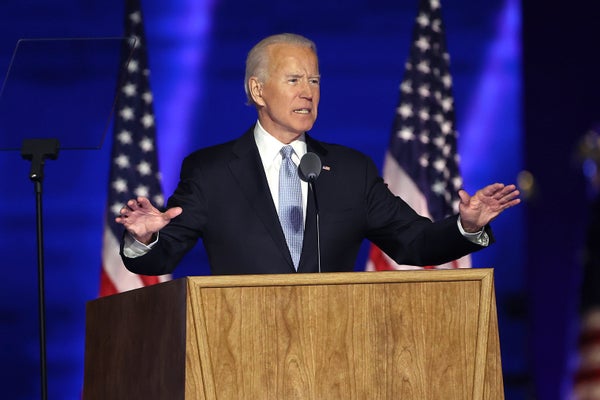
Former Vice President Joe Biden secured the 270 electoral votes needed to capture the White House on Saturday, major news organizations projected, after election officials in a handful of swing states spent days in round-the-clock counting of millions of mail-in ballots and early votes.
The Democrat’s victory came after the latest tallies showed him taking an insurmountable lead in Pennsylvania, a state both Biden and President Donald Trump had long identified as vital to their election efforts. Trump has signaled he will fight the election results in several states, filing a number of lawsuits and seeking recounts.
“America, I’m honored that you have chosen me to lead our great country,” Biden tweeted shortly after the news organizations called the race. “The work ahead of us will be hard, but I promise you this: I will be a President for all Americans—whether you voted for me or not.”
On supporting science journalism
If you're enjoying this article, consider supporting our award-winning journalism by subscribing. By purchasing a subscription you are helping to ensure the future of impactful stories about the discoveries and ideas shaping our world today.
The Democratic celebration was tempered because it appeared the party would have a hard time taking back the Senate majority it lost in 2014. If that bears out, it will likely keep Biden and Democratic lawmakers from enacting many of the plans they campaigned on, including major changes in health care.
Party control of the Senate may not be determined until January—thanks to what preliminary returns suggest will be runoffs for both Senate seats in Georgia. No candidate for either seat reached the required 50% threshold.
Without a Democratic majority in the Senate, Biden will likely face strong Republican opposition to many of his top health agenda items—including lowering the eligibility age for Medicare to 60, expanding financial assistance for health insurance under the Affordable Care Act, and creating a “public option” government health plan.
However, his administration would be a bulwark to defend the ACA against Republican attacks, although the Supreme Court case challenging the health law—which will be heard next week—presents a major wild card for its future.
Health care was a key element of Biden’s campaign, especially improving the federal response to the coronavirus pandemic. He championed the use of face masks and blasted the Trump administration for shifting to states much of the responsibility for fighting the virus and helping hospitals. He was regularly mocked by the president for wearing a mask, working and campaigning from home, and not having an in-person Democratic convention.
Even before the latest vote tallies were released late Saturday morning, Biden had begun moving toward setting up his administration. On Thursday his transition team unveiled a website, BuildBackBetter.com, although it was only one page. And the former vice president held a meeting Thursday with health and economic advisers on the coronavirus.
In a speech to supporters in Delaware Saturday night, the president-elect pledged again to make the pandemic his top concern, saying that until COVID-19 is under control, the country “cannot repair the economy, restore our vitality or relish life’s most precious moments, hugging our grandchildren, our children, our birthdays, weddings, graduations, all the moments that matter most to us.”
He announced that on Monday he would name “a group of leading scientists and experts as transition advisors” to help develop a blueprint “built on bedrock science” to combat the virus.
The electoral outcome is not the one Democrats were hoping for—or, to some extent, expecting, based on preelection polling. Andy Slavitt, who ran the Centers for Medicare & Medicaid Services during the Obama administration, noted that frustration in a tweet Wednesday. “A large disappointment is that many hoped for a significant repudiation of Trump & his indifference to human life, human suffering, his corruption, and goal of getting rid of the ACA. No matter the final total it will be hard to make that claim,” Slavitt said.
Still up in the air is how willing a Republican-led Senate will be to provide further relief to individuals, businesses and states hit hard by the pandemic, and whether they will participate in previously bipartisan efforts to curtail “surprise” out-of-network medical bills and get a handle on prescription drug prices.
This story was originally published by Kaiser Health News on November 7 2020. Read the original story here.