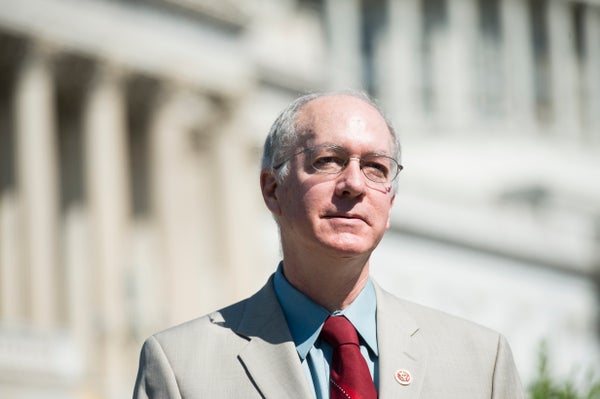
Bill Foster is a U.S. congressional representative of Illinois and a member of the Democratic Party. Before entering politics, he worked as a business executive and a physicist, including at the Fermi National Accelerator Laboratory (Fermilab), where he contributed to high-energy particle physics research.
[This interview was edited for length and clarity.]
How do you see the current state of American science right now?
On supporting science journalism
If you're enjoying this article, consider supporting our award-winning journalism by subscribing. By purchasing a subscription you are helping to ensure the future of impactful stories about the discoveries and ideas shaping our world today.
The strengths of America—our freedom, our dedication to scientific truth, our number one position in terms of the funding of science—are all under threat. And probably at the top of the long-term threats are the unwelcoming attitude of our current administration toward immigrants, even those with strong scientific credentials.
It’s very easy, sometimes, for Americans to forget how much of the scientific achievement that we’re proud of came from people who were not born in America but chose to come here because of the freedom and the opportunity.
What would you say needs to change in American science?
Well, we have to look honestly toward the past and understand how dependent our number one position in the world was on immigrants to this country. And we have to look to the future and understand that if we’re going to maintain that, we have to find a way to navigate the threats of the world today—everything from autocracies to artificial intelligence to you name it—and, at the same time, keep our allegiance to freedom and scientific truth.
If you had to give advice for an early-career scientist in the U.S., what would you tell them right now?
I would tell them not to be discouraged. There’s something magical about the search for scientific truth. The idea that there is something called an objective reality that can be measured by repeated experiment is really the basis of all progress that our species has made in the past centuries, and this will continue.
I would also urge them not to be discouraged about the incredible advances in artificial intelligence. These are going to be tools that will make scientific progress accelerate probably beyond what we can imagine. There’s a merit to simply being around and to being able to understand what will be produced by these incredible tools.
Has the U.S. lost its distinction as the destination for the best scientists in the world?
Well, I think we have to think more carefully about who we elect in office in the future. We tend to have an attitude—often in this country, and other countries have it as well—that when you’re unhappy with the state of politics, you just elect someone who will blow the whole system up. And we’re seeing the downside of that.
You know, even in times of stress, there’s a lot that’s important to keep our society healthy and our country growing. And the right answer is not to elect people who will deny fundamental scientific truths, such as climate [change] or the medical benefits of vaccines.
I think it’s important to think separately about issues that are pure science and issues that are actually human choices. You know, during a lot of the debates about reopening schools during [the] COVID [pandemic], it was not a completely scientific discussion, because you had to trade off the health of people who might die from COVID, who were largely the elderly, against the mental health of the next generation of children, who were being hurt very badly by not being in school. And so different human beings can come to different ways of weighing those two considerations.
And if we pretend as if just the fact that we’re scientists [means] that we have more insight into those very human decisions, I think we’re putting ourselves in danger of overstepping our bounds.
What do you think of the way that science is funded in the U.S.?
I think that going to a longer funding cycle, time-wise, going at least to a two-year budgetary cycle for science..., would have a real benefit, just to provide more longer-term certainty. As science gets more complicated, you need multiyear programs to get to the truth. It’s not like Benjamin Franklin’s experiments that determined that there were positive and negative charges, you know. [Those sorts of discoveries] did not require four-year research programs. But now a lot of things take many-year programs, and you need funding certainty for that entire period of time.
One of the most destructive things has happened with this administration is having DOGE come in not understanding what it is that’s at risk and just going and turning a wrecking ball to it. And when scientists see that happening to programs that have tremendous scientific respect, that makes it very discouraging and frankly discourages people from thinking about having a career in science in the U.S., right?
Is there an area of science that you would like to see more investment in?
From a policy point of view, I think there’s a real gap in rational risk—scientific approaches to rational risk. You know, we tend to, as a species, have a very irrational attitude toward risk [in] that we will worry about one specific incident that happens that is truly horrific without backing off and looking at the statistics and asking, “You know what? What is it going to cost to prevent that sort of horrific act versus the other ways that we could spend that money?” and maybe doing a lot more good, on net, for the people that we are allocating resources for. And so that’s one thing I think that both sides of the aisle would really benefit from.