
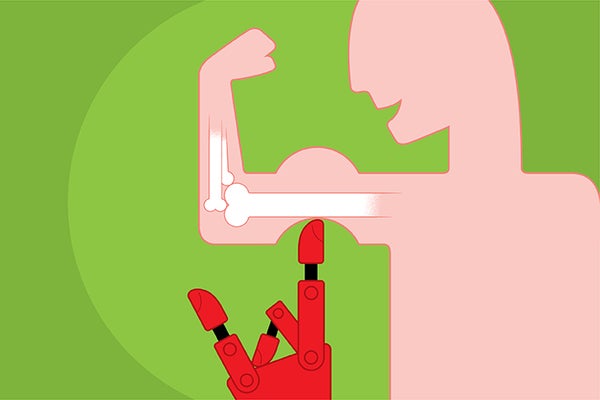
Human fingers don't just sense what a surface feels like. They also tell us a lot about what's underneath it: a really firm handshake, for example, can reveal where some bones are, and, with enough prodding, one can even locate tendons.
Inspired by this capability, scientists have developed a fingerlike device that maps an object's internal structures in 3-D by touching its surface. Earlier tactile sensors detected external shape, stiffness and texture but not subsurface details. For a study in Cell Reports Physical Science, the researchers tested their device by scanning simulated human tissue and electronic circuitry.
“This bionic finger has exciting application prospects in material characterization and biomedical engineering,” says study co-author Zhiming Chen, an engineer at China's Wuyi University. “The technology could also be incorporated into robots and prosthetics, which is our next research topic.”
On supporting science journalism
If you're enjoying this article, consider supporting our award-winning journalism by subscribing. By purchasing a subscription you are helping to ensure the future of impactful stories about the discoveries and ideas shaping our world today.
The new “finger” contains a carbon fiber tactile sensor, which returns a stronger signal when compressed against stiffer objects. The device moves across an object's surface, poking several times at each location to feel for increasing levels of pressure. This process can reveal subsurface details, such as hard layers inside softer materials. “When pressed by this bionic finger, hard objects retain their shape, whereas soft objects deform when sufficient pressure is applied,” says Wuyi engineer Jian Yi Luo, the study's senior author. “This information is transmitted to a computer, along with the recorded position, and displayed in real time as a 3-D image.”
Other imaging methods, including x-ray, PET, MRI and ultrasound, have their own pros and cons. X-rays carry health risks, and other options lack portability or speed. Many are expensive. The new device is unlikely to be significantly cheaper than ultrasound, but it may provide better resolution. “It offers another way of doing things, which has its own advantages in specific contexts,” says University College London engineer Sriram Subramanian, who was not involved in the work. “I don't think it's easy to do ultrasound imaging of printed electronic circuits.”
In simulated human tissue, the device pinpointed bones and a blood vessel. For a flexible electronic circuit encapsulated in soft material, it detected a circuit break and an incorrectly drilled hole. “When we make those [devices], we always worry that if something is broken, the only way you can know is to take it apart,” Subramanian says.
The device will struggle to map objects whose outer surface is too hard, and it may miss details underneath hard layers. The researchers plan to extend their invention into more dimensions, however, perhaps probing from other directions as well. “This system might be expanded to multiple fingers, just like our hands, to realize ‘omnidirectional’ detection,” Chen says. “This would enable it to get more complete information.”