
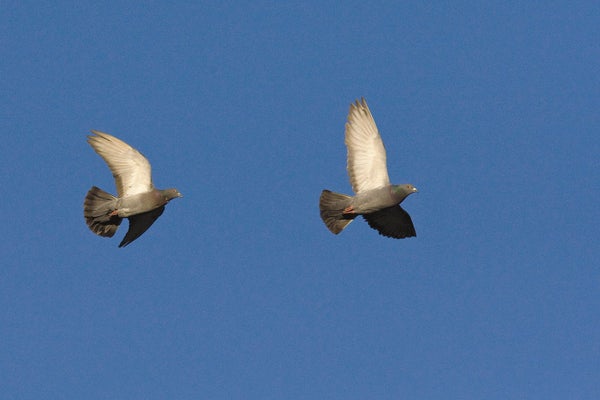
A group of birds flitting in unison is awe-inspiring to humans, and the birds themselves get predator protection and navigational help from their companions. A new study finds pigeons pay an enormous cost to fly together, even in pairs—yet they still choose to do it.
Certain birds, such as geese, travel in V formations to save energy by using the airflows their neighbors create. But smaller species such as pigeons flock in disorganized groups where this benefit would not apply; a 2011 study found pigeons actually flap faster, thus working harder, when in tight clusters.
To examine this phenomenon more closely, scientists at the University of Oxford and Royal Holloway, University of London, tracked pigeons' flap frequency and flight paths when flying alone and in pairs. They found that the birds beat their wings once more per second when in a pair—an 18 percent increase in frequency from flying alone and a much bigger leap than going from spread-out groups to dense ones in the 2011 study. Nevertheless, most pairs remained together. The new work was published in June in PLOS Biology.
On supporting science journalism
If you're enjoying this article, consider supporting our award-winning journalism by subscribing. By purchasing a subscription you are helping to ensure the future of impactful stories about the discoveries and ideas shaping our world today.
Study authors propose that when trying to stick together, the birds flap faster to improve their control and visual stability. “They fly really quite fast,” says lead author Lucy Taylor of Oxford. “You're having to fly at speed and not hit anything, and that's kind of an amazing feat.” Tracking devices on the pigeons suggest higher wingbeat frequencies did keep them more stable, although University of Montana researcher Bret Tobalske says a more direct measurement—such as from cameras affixed to the birds' heads—would be needed to know definitively. “I think that it's novel and important work that's building on the previous work,” says Tobalske, who studies bird flight and was not involved in either study.
Taylor thinks the increase in energy use between pairs and larger flocks would be much smaller than the jump from single to pair because flocking in groups simply builds on the new challenges created by flying with a partner. “You're then having to coordinate with another bird,” she says. “When you have more birds, it may require more coordination.” But Taylor adds that the experiment should next be scaled up to see how things change as the flock gets bigger.
Yet even pairing up provides benefits. The researchers found the pigeons' routes were more direct when they had partners. Each bird would also have a partner helping to look out for approaching predators—and a chance the predator might eat its companion instead.
Pigeons accept the energy cost for these benefits because, as Tobalske puts it, “nothing in life is free.”