
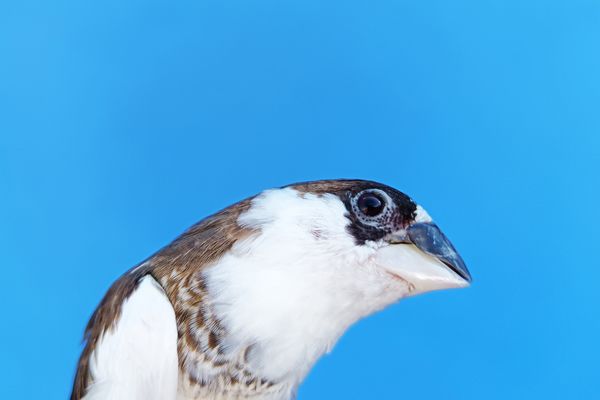
The twittering of songbirds may bear little resemblance to human speech, but new research on Bengalese Finches shows that their vocalizations do follow a fundamental structural principle found in all languages. Zipf’s law states that a handful of words—or, in this case, chirps, whistles and trills—occur frequently, while most are rare. Specifically, the most common word (“the,” in English) appears roughly twice as often as the second-most common (“of”), three times as often as the third most common (“and”), and so on.
This peculiar frequency distribution was also documented last year in humpback whale song, meaning it has emerged in at least three evolutionary lineages that are separated by millions of years. Though these wordlike units in songbirds and whales probably don’t convey specific meaning in the way that human words do, these discoveries challenge the notion that human language is wholly unique, says Simon Kirby, a cognitive scientist at the University of Edinburgh and a co-author of both the whale and songbird studies. “We suddenly have these unrelated species that do something similar to what humans do,” he says. “This gives us a new dividing line, a new way of carving up communication systems in the world.”
The dividing line, as Kirby sees it, lies between species that learn their vocal signals culturally and those whose calls are genetically built-in. Much like language, the songs of humpbacks and many songbirds get transmitted from one generation to the next. Because so-called Zipfian word distribution is known to help human infants pick up language from the adults around them, it stands to reason that similar patterns may aid learning in young birds and whales, too.
On supporting science journalism
If you're enjoying this article, consider supporting our award-winning journalism by subscribing. By purchasing a subscription you are helping to ensure the future of impactful stories about the discoveries and ideas shaping our world today.
It’s not clear why Zipfian distribution is easier to learn; maybe the few common words (or chirps) serve as familiar anchor points, allowing listeners to draw boundaries around neighboring words. “If you’re hearing this stream of sound, you don’t know where the edges [of words] are,” Kirby explains. “But [once] you’ve recognized something, then that gives you a way in.”
The researchers themselves faced this very problem when they analyzed birdsong. How do you tell one unit from the next if you don’t speak finch? But they applied the same method they had developed for parsing whale song. This was a simple algorithm inspired by how babies are thought to parse language: listen for uncommon sound transitions, which are more likely to occur between words than within them. The team sliced up a few hundred samples of birdsong at those transitions and measured how often each of the segmented units appeared. The results, published today in Science Advances, closely matched Zipf’s law, just as with humans and humpbacks. Next the researchers plan to look for more parallels with human language, beyond just Zipf’s law, that may facilitate learning in these species.
“It’s just one property, and we’re expanding into other ones,” says Inbal Arnon, a psychologist at the Hebrew University of Jerusalem and co-lead author of the new study with Kirby and Kazuo Okanoya, a biopsychologist at Teikyo University in Japan.
Other potential explanations for Zipfian distribution in animal communication don’t involve cultural transmission. Richard Futrell, a computational linguist at the University of California, Irvine, who was not involved in the new study, notes that “there are a million different things that can give rise to Zipf’s law.” It crops up in earthquake magnitudes, solar flare intensities and city population sizes, to name a few. Still, Futrell adds, Kirby and his colleagues “are incrementally building up this case that there’s [a] connection between Zipf’s law and learning.”
Editor’s Note (8/20/26): This article was updated after posting to include comment from Inbal Arnon and to clarify the co-lead authors of the new study.