
Science is all about expanding the realm of human perception. Sometimes that means making the invisible visible, like when Galileo turned a telescope toward Jupiter, discovered moons around another planet and changed our literal worldview. We now know that flowers, as beautiful as they are to us, are communicating with birds and bees using ultraviolet patterns we can’t see and that elephants can feel vibrations travel through the ground from miles away.
People have been observing birds singing and calling since there were people. Birds vocalize to attract mates, defend territory, find one another, and more. Many birds’ songs sound musical to us, with distinct notes that are repeated in pleasing patterns at a steady speed—melody, rhythm and tempo, basically. But as Adam Fishbein and other bird researchers have discovered recently, what sounds so entrancing to us isn’t that meaningful to them. Birds don’t seem to listen to the melody so much as to fine details within each note that humans can’t detect.
Most parasites are invisible, although some are not (like tapeworms, yikes). Beauty is in the bird’s ear or the scientist’s eye of the beholder, and there’s a growing movement to recognize that parasites can and do go extinct and should be protected. As science journalist Rachel Nuwer writes, as many as 40 to 50 percent of all animal species are parasites, and almost every other species has at least one parasite that has evolved to parasitize it.
Parasites are one of the problems plaguing fish farms. When you concentrate fish in huge pens, parasites and diseases spread rapidly and can escape to wild-living animals. Now scientists and science-informed aquaculturists are experimenting with environmentally and financially sustainable fish-farming practices. Author Ellen Ruppel Shell takes us to Maine, where the commercial fisheries of cod, shrimp and mussels have crashed, and the climate emergency is pushing lobsters to cooler Canadian waters. Farmed shellfish and even enormous finfish operations being developed there could be the future of seafood.
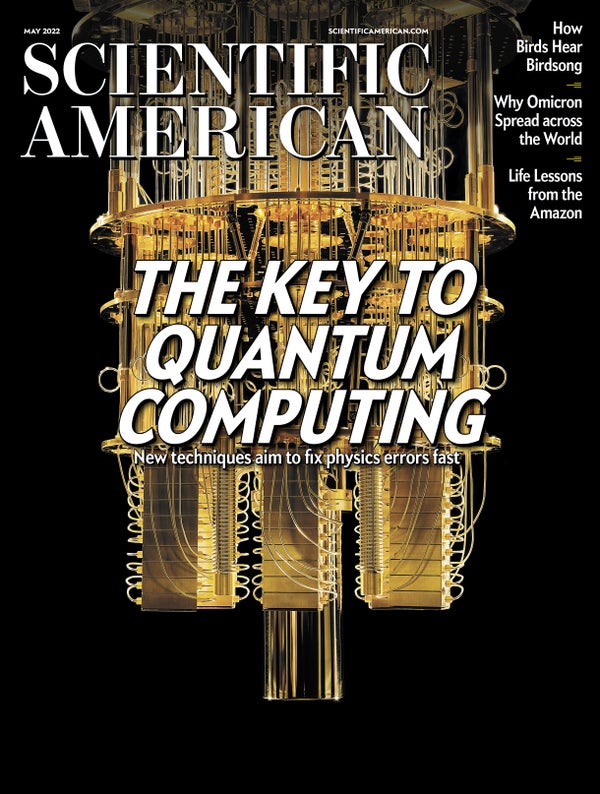
The future of computing is the subject of our fascinating cover story this month, by quantum theorist Zaira Nazario. Quantum computing uses basic units called qubits (analogous to the bits in classical computers but in the form of waves rather than 1s and 0s) that are linked together through quantum entanglement. Quantum computers can store and manipulate information at scales and speeds far beyond anything classical computers can do, but they also suffer from errors unlike anything in classical computers. Nazario specializes in fixing these errors, and here she narrates the challenges and discoveries and delights of this important and mind-bending work, with graphics that help make invisible quantum quirks visible.
The Ashaninka people have a different sort of vision for what’s possible. They have seen parts of the Amazon destroyed by loggers, miners and drug runners, and they’ve been exploring sophisticated and creative methods for protecting their homeland. In an unusual (for us) collaboration, anthropologist Carolina Schneider Comandulli and the Apiwtxa Association share one community’s worldview and how it has inspired them to create a sustainable, self-sufficient way of life and empowered other Indigenous people in the Amazon and their allies to protect and rebuild habitat. Turn here to enjoy the stunning accompanying photography.
We have just witnessed what is almost certainly the fastest-spreading human virus in history, the Omicron variant of SARS-CoV-2. Science journalist Megan Scudellari and graphic artist Veronica Falconieri Hays show why this variant is so good at what it does. Omicron has more genetic mutations than previous variants of concern, starting with mutations that allow it to hide from the human immune system. And more variants are coming. We hope you’re able to stay as safe and healthy and well informed as possible, as science helps us see and hear and fix things that we can’t easily perceive.