
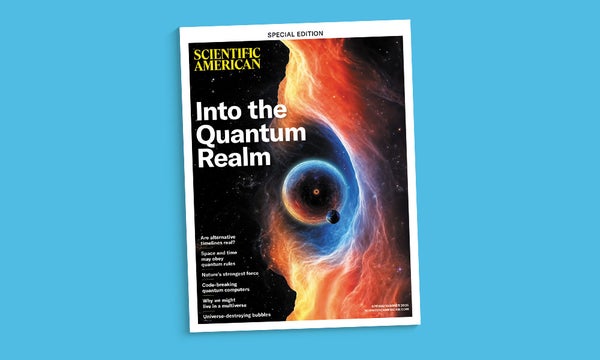
In 2022 three scientists won the Nobel Prize in Physics for proving something astonishing: the universe is not locally real. In other words, particles don’t have fixed properties until they are measured. Although it seems to counter everything we perceive, the discovery was established by some of the most rigorous experiments ever conducted, and it aligns with a prediction Albert Einstein and his colleagues made almost 100 years ago: that particles strangely influence one another, even across vast distances. Today quantum strangeness is no longer confined to theory. Researchers are entangling objects large enough to see, quantum computers are on the cusp of solving problems no classical machine can touch, and speculative ideas such as vacuum decay and alternative realities are serious science. The quantum era has arrived.
Bizarre quantum dynamics underpin our view of reality: Time travels forward for us, but in the quantum world, it may flow in two directions. Gravity itself may follow quantum rules. Quantum mechanics supports the possibility of alternative universes, but even if they exist, we can’t access them (and probably shouldn’t anyway). Some physicists argue that quantum rules dictate that everything in the universe is preordained, making free will an illusion, so we might as well accept our current reality.
These insights are fueling tremendous scientific innovation. The strongest force in nature, which binds together quarks inside protons and neutrons, may be dictated by quantum interactions. Scientists have found that electrons swarm in a soup of quantum entanglement in a recently discovered class of materials called strange metals. An experiment housed deep underground in a Sardinian mine is designed to determine the weight of empty space—yes, it weighs something—and thereby isolate particles predicted by quantum field theory. To better understand the most inexplicable behavior of quantum particles, physicists have created lattices out of light waves that simulate solid materials.
On supporting science journalism
If you're enjoying this article, consider supporting our award-winning journalism by subscribing. By purchasing a subscription you are helping to ensure the future of impactful stories about the discoveries and ideas shaping our world today.
If many universes exist, the stars and planets that were able to form in ours could be the best evidence for them. But even how matter exists in the first place is a mystery to physicists. The universe seems stable, but an unlikely shift in the Higgs field, a quantum field that pervades all of space, could trigger a bubble that passes through the universe, annihilating all matter.
Perhaps the most tangible application of quantum discovery is in computing. The key to quantum computing is the qubit, and it promises to make electronic machines obsolete. In a type of computing arms race, researchers are trying to build systems that can withstand the might of future quantum-armed hackers. Despite the hype and parade of press announcements from big tech, however, so far no company has achieved “quantum advantage”—that is, a quantum computer able to solve a problem no classical computer can.
For corporeal creatures such as humans, grappling with a universe that might not be singular, time that moves in many directions, and matter that both does and does not exist is mind-bending, to say the least. Two giants in early quantum theory, Werner Heisenberg and John Bell, speculated that because we perceive as we do, the mind, in a sense, defines quantum interactions. Its implications are cosmic, but the quantum realm is definitively a human one.