
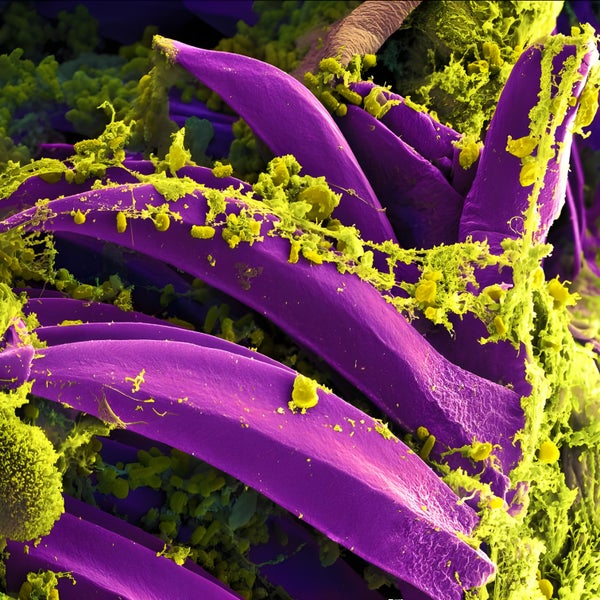
A small genetic change makes the bacterium that caused the plague less fatal but possibly more transmissible, allowing for greater disease spread in smaller populations, a study in Science reports.
The bacterium Yersinia pestis caused the Black Death — killing up to 50 million people in the mid-fourteenth century — as well as an earlier plague across the Mediterranean in the sixth century ad . The bacteria still circulate in low levels in parts of the United States, Africa and Asia, and are typically transmitted to humans by infected fleas carried by rats or other rodents.
Previous research found that some strains of Y. pestis had reduced amounts of pla, a gene associated with disease severity, but it was unclear why, says Ravneet Sidhu, a palaeogeneticist at McMaster University in Hamilton, Canada, and a co-author of the latest work. “Our findings in this study characterize a case in which a pandemic-causing pathogen has independently evolved to cause what we believe is a slightly weaker form of the disease,” she says.
On supporting science journalism
If you're enjoying this article, consider supporting our award-winning journalism by subscribing. By purchasing a subscription you are helping to ensure the future of impactful stories about the discoveries and ideas shaping our world today.
Mice mortality
To understand the impact of the genetic change, the team infected mice with modern strains of Y. pestis that had normal levels of pla , had reduced levels of the gene or were unable to express it at all. When the bacteria were injected beneath the skin to mimic the form of plague that affects lymph nodes, mice infected with the reduced- pla strain lived for almost two days longer than did those infected with the normal strain. Mortality also decreased from 100% with the normal strain to 85% with the reduced- pla strain. However, when the team infected mice intravenously or through the nose to mimic blood- or lung-based infections, the pla -reduced strain was as fatal as the normal strain.
The team also looked at the genomes of ancient and modern strains of Y. pestis to find out how prevalent pla depletion was. Between 30% and 50% of ancient strains obtained from previously published studies showed signs of depletion, as did three modern strains, isolated from a human and two rats in 1994. Wanting to understand why pla was depleted, the researchers analysed the genetic data from these ancient and modern strains. They found that the reduction was caused by deletion of a 2,100-base-pair-long region of DNA containing the pla gene in one region of the genome, and the integration of a DNA molecule called a plasmid carrying the gene into other regions.
Sidhu says the team hypothesized that pla depletion occurred because repeated outbreaks of the plague decreased the density of rodent populations. Increasing the time for which rats were infectious would have given them more time to travel between fragmented populations, increasing the chance of them spreading the disease, she adds.
Small change, large effect
The findings show how small genetic changes can have significant effects on pathogen transmission, says Francesca Short, a microbiologist at Monash University in Melbourne, Australia. “This isn’t even a deletion of a gene,” she adds. It is a dosage change that has emerged multiple times in history, and the authors have plausibly linked that change to reduced virulence and potentially increased transmission, Short says.
Sidhu is hesitant to extrapolate the findings on Y. pestis to other pandemic-causing pathogens, such as the coronavirus SARS-CoV-2, because it is likely that the genetic change was favourable only at the end of outbreaks, when the more fatal strain was unable to survive. “In reality, to understand how other diseases behave, we require specific research into those diseases from multiple fields, including theoretical and experimental evolution,” Sidhu adds.
This article is reproduced with permission and was first published on May 29, 2025.