
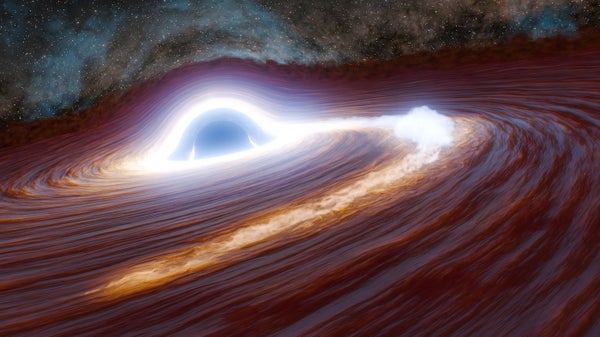
Black holes can get energy boosts by ‘snacking’, although their dish of choice is rather different from our own. Analysis suggests that the most luminous burst of light ever detected from a black hole — a fireworks show that was, at its peak, more than 10 trillion times brighter than the Sun — flared up as the black hole gobbled up a star that was at least 30 times as massive as the Sun.
The findings were published on 4 November in Nature Astronomy.
When astronomers first laid eyes on the object in 2018, they didn’t realize it was a superflare. After noticing the object brighten, researchers zeroed in on it with the Palomar Observatory’s 200-inch Hale Telescope. But a graph of the light emitted by the object proved disappointing. “It didn’t seem nearly as interesting as we thought it was,” says Matthew Graham, an astronomer at the California Institute of Technology in Pasadena and a co-author of the paper.
On supporting science journalism
If you're enjoying this article, consider supporting our award-winning journalism by subscribing. By purchasing a subscription you are helping to ensure the future of impactful stories about the discoveries and ideas shaping our world today.
However, in 2023, the team noticed that, even after five years, the black hole remained peculiarly bright. So they took a closer look using the W. M. Keck Observatory in Hawaii, which revealed that the object was roughly 3 million kiloparsecs, or 10 billion light years, away. To appear so bright at such a great distance, the jets of light must have been particularly luminous. Astronomers now say that the flare is 30 times more luminous than any previously detected blaze of light from a black hole.
A trick of the light?
The authors investigated several possible causes of the flare. Perhaps there was a supernova near the black hole, or the flare was merely a trick of the light, appearing much brighter than it was in reality because of gravity’s warping effects. But the team found that neither explanation matched well with observations.
Their leading theory, the authors say, is that a massive star met its doom while straying too close to the black hole. As the black hole’s gravity shredded the star, its jets of light flared about 40 times brighter than they did before. The team also thinks that because the flare has yet to completely die down, the star still hasn’t been fully consumed.
As astronomers continue to watch the star’s demise unfold, Joseph Michail, an astronomer at the Harvard and Smithsonian Center for Astrophysics in Cambridge, Massachusetts, is interested to see whether the jets will gradually dim, or perhaps flare up again as the light reaches surrounding gas and dust. He also thinks that future sky surveys might soon allow researchers to find many more beacons like this one. “These probably are going to become normal events,” Michail says.
Graham thinks that if astronomers are to fully understand the mysterious flares, they’ll need to keep their eyes on the sky for some time to come. This black hole is so distant from the Solar System that it takes about seven Earth years to witness just two years of the black hole’s activity. Astronomers can effectively watch the black hole devouring the star at only one-quarter speed. To witness more of these events in totality, “it’ll be a very long game”, Graham says.
This article is reproduced with permission and was first published on November 4, 2025.