
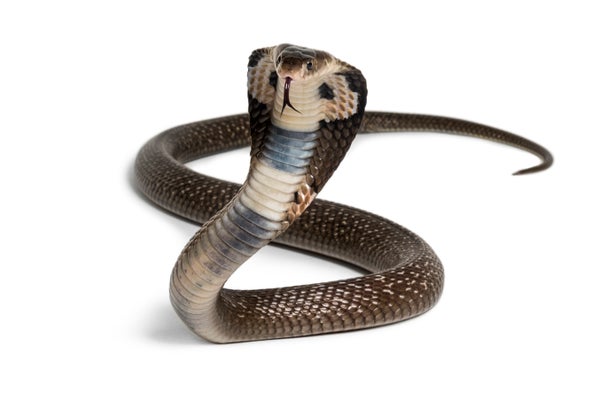
Scientists have made a potent antivenom using antibodies from a man who has been bitten hundreds of times by venomous snakes. The therapy protects mice against the venoms of 19 species of deadly snake, including the king cobra (Ophiophagus hannah).
The antivenom combines the existing drug varespladib with antibodies that are copies of those in the blood of Tim Friede, a US snake collector who has given himself more than 600 doses of venom to build up his immunity. He has also been bitten roughly 200 times by venomous snakes. The antivenom is reported today in a paper in Cell.
Scientists say that the research could lead to direly needed treatments, but that its reliance on material from a person who performed dangerous experiments on himself makes it ethically murky. The paper’s authors say they played no part in Friede’s self-exposure to venom. “We did not advise Friede to do this and no one else needs to do this again — we have all the molecules we need,” says co-author Jacob Glanville, chief executive of biomedical firm Centivax in South San Francisco, California. “Snake venom is dangerous,” he adds, and he cautions people not to follow Friede’s example.
On supporting science journalism
If you're enjoying this article, consider supporting our award-winning journalism by subscribing. By purchasing a subscription you are helping to ensure the future of impactful stories about the discoveries and ideas shaping our world today.
Imperfect remedies
Current antivenoms are made by injecting horses and other animals with snake venom and then gathering the resulting antibodies. Each antivenom protects against the venom of at most a few species.
“Considering the advanced technologies available in immunology today, it is unacceptable to continue relying on these outdated methods for treating snake bites,” says Kartik Sunagar, a biologist who develops antivenoms at the Indian Institute of Science in Bengaluru.
The paper’s authors sought to make an antivenom that would protect against a wide range of the world’s 600-plus venomous snake species. As a start, the team focused on the Elapidae family, which includes nearly half of those species. Elapid venom contains peptides called short-chain neurotoxins (SNX) and long-chain neurotoxins (LNX). Both types of peptide bind to the same receptors on nerve cells, impairing communication between neurons and potentially causing muscle paralysis and respiratory failure.
Don’t try this at home
Glanville and his co-author Peter Kwong, a biochemist at Columbia University in New York City, had read news coverage about Friede, who took careful notes about his venom exposure. After receiving approval from an ethics review board, getting informed consent from Friede, and supplying him with documents about the dangers of snake venom, the team collected two vials of Friede’s blood. They isolated antibodies from it and tested them against a panel of toxins from elapid snakes. Antibodies that bound to the toxins were then tested in mice that had been dosed with snake venom. Seeking to add protection against even more species, the researchers tested a third element: varespladib, which inhibits a snake-venom enzyme that breaks down muscle and nerve tissue.
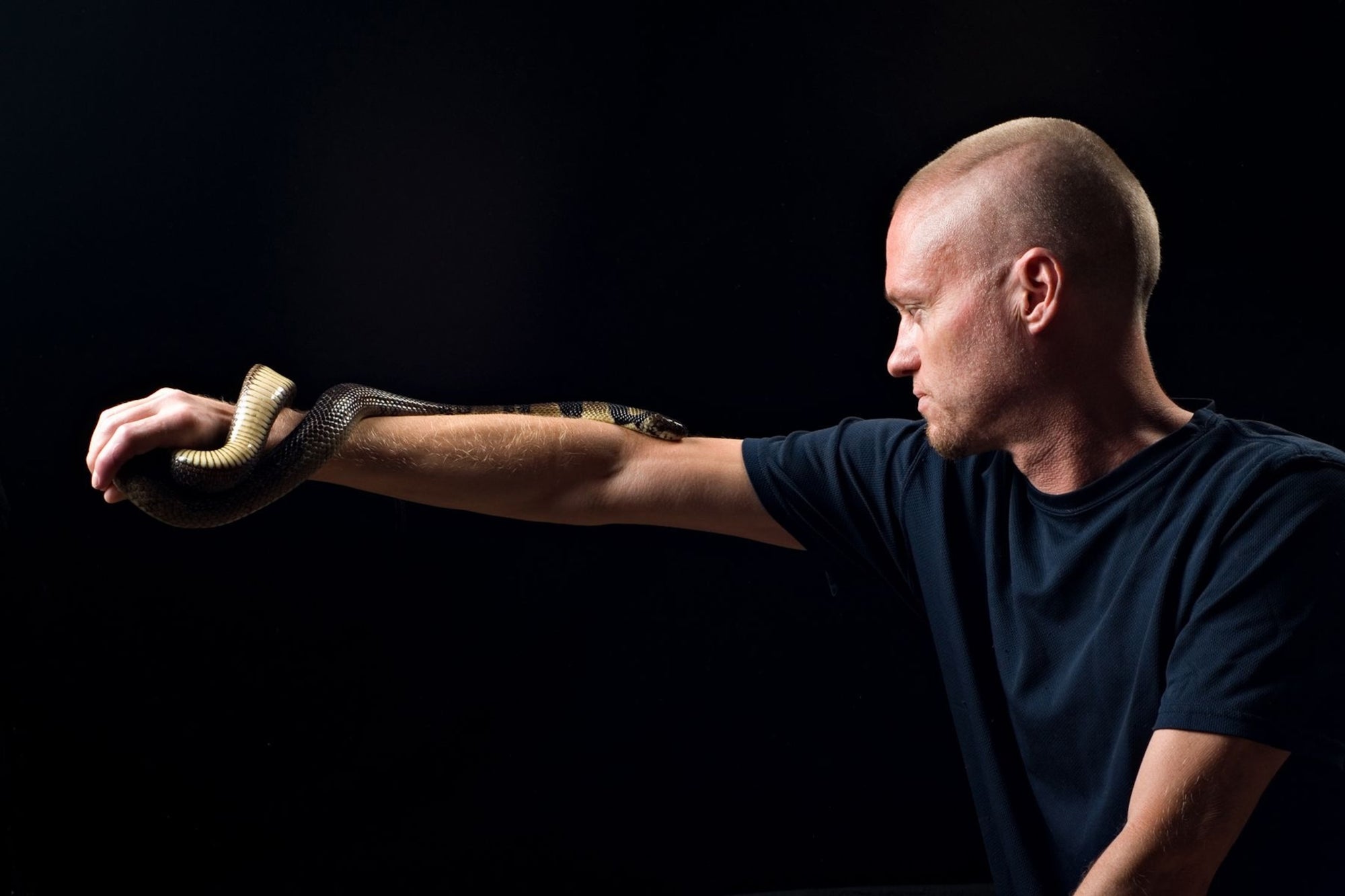
Antibodies from snake collector Tim Friede, here with a water cobra (Hydrodynastes gigas), have been used to make a broad-spectrum antivenom.
Centivax
They found that a cocktail made up of varespladib and two antibodies from Friede allowed mice to survive otherwise lethal doses of venom from any one of 19 species of dangerous elapid snakes. One of the antibodies binds to a molecular feature shared by toxins in the LNX family. The other binds to a feature shared by toxins in the SNX family.
Glanville says that exact copies of human antibodies could pose less risk of adverse reactions than those based on animal antibodies and broad-spectrum synthetic antibodies designed with computational approaches.
Sunagar and other scientists expressed concerns about the ethics of this research, because of the risks Friede took. But he also says that the study is well executed, and shows that combinations of small-molecule drugs such as varespladib and monoclonal antibodies — copies of human antibodies — hold promise. However, it’s not clear whether these antibodies can be produced at an industrial scale for an affordable price, he says.
Jean-Philippe Chippaux, a specialist in venomous-snake bites and an emeritus researcher at the French National Research Institute for Sustainable Development in Paris, says that the main challenge in addressing snake bite is not the efficacy of the treatments, but the fact that they are often administered too late. “We need to think about ways to bring antivenoms closer to the areas where venomous snake bites occur and to convince patients to come to the hospital more quickly,” he says. “There is no reason to believe that the new generation of broad-spectrum antibodies will achieve these results.”
Glanville says he is thinking about ways to make these therapies more portable and affordable. He also says it’s important to provide proof that the cocktail works in the real world before initiating any human trials.
Centivax is planning to test the experimental cocktail in dogs bitten by snakes in Australia. Dogs will first be given the experimental treatment; if it doesn’t work after a few minutes, they will receive conventional antivenom.
This article is reproduced with permission and was first published on May 2, 2025.