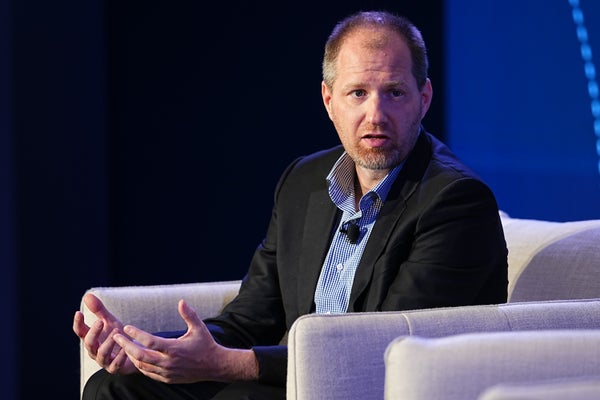
Bob Mumgaard is an engineer and entrepreneur who co-founded Commonwealth Fusion Systems and serves as its chief executive officer. Trained in applied plasma physics at the Massachusetts Institute of Technology, he has worked on fusion energy technologies and efforts to commercialize fusion power.
[This interview was edited for length and clarity.]
How would you describe the current state of American science?
On supporting science journalism
If you're enjoying this article, consider supporting our award-winning journalism by subscribing. By purchasing a subscription you are helping to ensure the future of impactful stories about the discoveries and ideas shaping our world today.
In America, science innovation is very good, and the tools are getting even better. At the same time, we are seeing institutions under threat, both internally and externally, and an overall erosion of trust in science. As a result, some of the public doesn’t really understand what they get from science.
This is unfortunate because the ability of science to make a meaningful difference in the world is accelerating. We have better tool sets, whether in artificial intelligence or other computational tools, and that gives us better ways to model and analyze things. A single researcher has more power in their fingertips today to analyze data than entire institutions had even 10 years ago. For every field of science, the ability to work with huge datasets, sophisticated simulations and new ways to manipulate things will only make research faster and better.
What needs to change in American science?
While science is getting faster, it still takes time to produce results. We don’t have the long-term stable investment base that will allow us to realize the gains. At the federal level, for example, funding is not there, especially if you’re fighting every year for a budget and the priorities for what you should research change every four years.
We are, in some ways, overconstrained by bureaucracy, contrasting with China, [where it] is getting faster and easier to get things done. The fact that an increasing number of new drugs are licensed from China because the cost to run a clinical trial there is so much lower should be concerning. But I also think it is indicative of the costs to innovate across the whole ecosystem.
What gives you optimism right now?
The tools—the ability to automate data production, analyze large datasets, and gain insights faster and faster, married to the number and complexity of challenges, makes now a very rich time to be inquisitive. We have interesting challenges we can look at, and we have the ability to say, “I bet we can now handle this.” Whether in areas such as fusion—or in drugs by design for diseases such as Alzheimer’s and Parkinson’s or in [the creation of] materials we never thought possible—our ability to use new tools to tackle some of these big, meaty problems is super exciting.
What’s your best advice for an early-career scientist?
Find something that deeply interests you in a space that is not crowded. If it’s crowded, you’re too late. You want to be on the front edge. The risks of not making an important contribution are much lower today, with the explosion of new techniques, than it was even 10 years ago.
How has your field changed in the past few years?
It’s unrecognizable. The commercialization of fusion science has led to an excitement about the field and an influx of a diverse set of people with different backgrounds that have brought new ideas and tools. They have taken ideas that were stuck and given us new levers to solve them.