
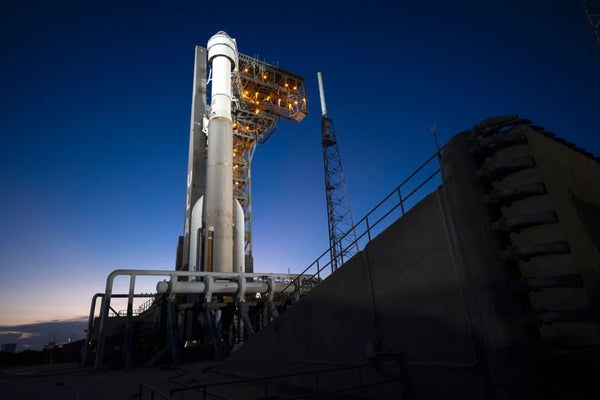
Boeing's Starliner capsule will join a very exclusive club today (May 6), if all goes according to plan.
A United Launch Alliance Atlas V rocket is set to launch Starliner and its two passengers, NASA astronauts Suni Williams and Butch Wilmore, from Florida's Cape Canaveral Space Force Station today at 10:34 p.m. EDT (0234 GMT on May 7). You can watch the action live at Space.com, courtesy of NASA.
The liftoff will kick off Crew Flight Test (CFT), a roughly 10-day shakeout cruise to the International Space Station (ISS) that will be Starliner's first-ever astronaut mission. Such crewed debuts to Earth orbit have happened just five times in American history, as NASA chief Bill Nelson noted during a press briefing on Friday (May 3).
On supporting science journalism
If you're enjoying this article, consider supporting our award-winning journalism by subscribing. By purchasing a subscription you are helping to ensure the future of impactful stories about the discoveries and ideas shaping our world today.
"So, you think of it: The first time [NASA astronauts] have flown on a new spacecraft started with Mercury, then with Gemini, then with Apollo, then space shuttle, then Dragon and now Starliner," Nelson said. "So it is a historical day; it's a wonderful day."
Dragon is the capsule built by SpaceX, which, like Boeing, won a contract from NASA's Commercial Crew Program back in 2014 to carry agency astronauts to and from the ISS.
The goal was to get at least one American crewed vehicle up and running as soon as safely possible in the wake of the space shuttle's 2011 retirement, which left NASA completely dependent on Russian Soyuz spacecraft for crewed transportation services to and from the ISS.
SpaceX launched its version of CFT, called Demo-2, in May 2020. Elon Musk's company has since completed seven operational astronaut missions to the station, and it's in the middle of its eighth, which launched in March. As that record shows, SpaceX has proven to be a reliable and prolific partner for NASA. But the agency is still excited to get a second American astronaut taxi online, given how complex and demanding human spaceflight is.
"This will give us that additional capability, because we always look for a backup," Nelson said.
If all goes well with CFT, Starliner could launch its first contracted, six-month crewed mission to the ISS as soon as early 2025.
CFT's launch will be historic in other ways as well. For example, it will be the first-ever astronaut liftoff for the venerable Atlas V, and the first crew-carrying mission for any member of the Atlas rocket family since May 15, 1963. On that day, an Atlas LV-3B launched Faith 7, the final mission of the Mercury program, which sent NASA astronaut Gordon Cooper into orbit for 34 hours and 20 minutes.Nelson also noted another special aspect of tonight's liftoff: It will mark the first time since the May 1968 launch of Apollo 7 that a crewed mission leaves Earth from Cape Canaveral Space Force Station (or, in its former incarnation, Cape Canaveral Air Force Station).Many astronaut missions have lifted off from Florida's Space Coast since then, including those flown by NASA's space shuttle and SpaceX's Dragon. But those flights all launched from NASA's Kennedy Space Center, which is next door to Cape Canaveral Space Force Station.
Copyright 2024 Space.com, a Future company. All rights reserved. This material may not be published, broadcast, rewritten or redistributed.