
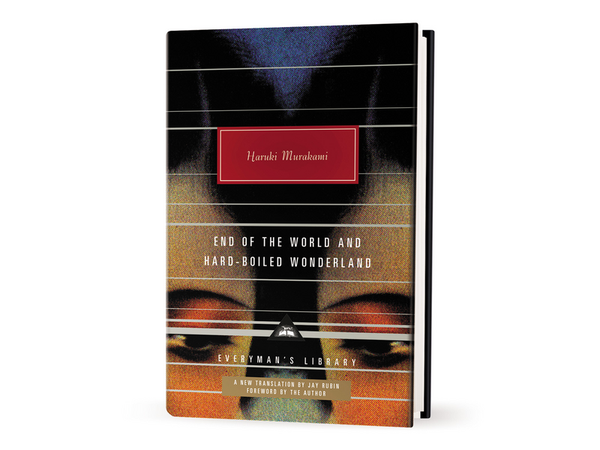
End of the World and Hard-Boiled Wonderland: A New Translation
by Haruki Murakami. Translated by Jay Rubin.
Everyman’s Library, 2024 ($30)
First translated from the Japanese in 1991 by Alfred Birnbaum, Haruki Murakami’s award-winning 1985 novel is a tale of two worlds. One is a clever pastiche of cyberpunk and detective tropes where rival syndicates secretly vie for dominance; the other is a surreal fantasy where “old dreams” are read from the skulls of mysterious one-horned creatures. In a new translation, longtime Murakami translator Jay Rubin restores, at the author’s request, roughly 100 pages of previously excised material.
This new material noticeably lengthens the novel but doesn’t significantly increase its pleasures—pleasures one reaches only by wading through too much juvenile erotica and misogyny, including a novel-length depiction of a 17-year-old character termed the “fat girl,” whose body composition and sexual possibility are central preoccupations. Still, Murakami fans will enjoy the chance to read the novel in a form closer to the author’s original intent and make comparisons between the familiar Birnbaum and Rubin’s newer effort. Rubin nonetheless keeps many of Birnbaum’s choices intact, including the names of the secretive Calcutecs and their criminal rivals, the Semiotics.
On supporting science journalism
If you're enjoying this article, consider supporting our award-winning journalism by subscribing. By purchasing a subscription you are helping to ensure the future of impactful stories about the discoveries and ideas shaping our world today.
Rubin has chosen to revert the title’s order in English to that of the original Japanese, giving primacy to the better of Murakami’s settings, the mysterious walled town called End of the World. Here the translator’s decisions matter considerably, with Rubin choosing “heart” (instead of Birnbaum’s “mind”) for the apparently difficult-to-translate kokoro, which Rubin explains actually “straddles the full territory” of mind, heart and morality.
Although the relative limitations of English occasionally risk reduced complexity, the resulting language often still moves, as when one narrator pledges his emergent dream-reading skills to help his romantic interest recover her lost heart, her missing kokoro: “The heart is not like raindrops,” he promises. “It doesn’t fall from the sky, indistinguishable from other things ... I’ll find it for sure. Anything and everything is here, and anything and everything is not here.” As it is when Murakami’s two storylines finally come together, it’s where mind, heart and morality converge that End of the World and Hard-Boiled Wonderland is at its best.