
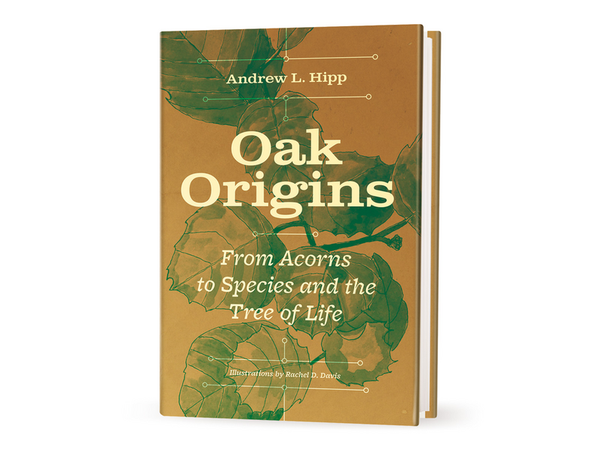
Oak Origins: From Acorns to Species and the Tree of Life
by Andrew L. Hipp. Illustrated by Rachel D. Davis.
University of Chicago Press, 2024 ($35)
In many parts of the world, if you take a walk in the woods, you are likely to encounter an oak tree. With 425 species worldwide, their collective abundance may lead one to believe these trees are somewhat unremarkable—a fixture we take for granted. But Andrew L. Hipp, a botanist and research director at the Morton Arboretum in Illinois, reveals that oaks are a dynamic and essential part of the forest.
Oaks have been on naturalists’ radar for some time. In On the Origin of Species, Charles Darwin highlighted European oaks as an example of species variation. The advent of DNA technology, though, offered a sharp new lens on what Hipp calls one of oaks’ “superpowers”: their ability to breed with other oak species while still maintaining some of their original genetic qualities.
On supporting science journalism
If you're enjoying this article, consider supporting our award-winning journalism by subscribing. By purchasing a subscription you are helping to ensure the future of impactful stories about the discoveries and ideas shaping our world today.
After oaks first appeared—56 million years ago—they expanded their range, adapting to diverse environments through natural selection. They began to diverge into distinct species at least 45 million years ago. Yet a California scrub white oak can reproduce with an Engelmann oak. Hipp contrasts this knack with humans’ inability to procreate with chimpanzees, even though our evolutionary split was far more recent.
Oaks’ capacity to hybridize without merging brings out fascinating nuances in the so-called Tree of Life. This visual metaphor separates species into distinct branches. But look closely at the oaks’ section, Hipp says, and “you will find strands of gossamer trailing between the branches, genes moving between lineages.”
He gently guides readers through these complexities, laying the groundwork for lucid explanations about the trees’ evolution and biology. In one analogy, he compares oaks’ prodigious potential for genetic recombination with the extensive postproduction tape-splicing that created Miles Davis’s song “Pharoah’s Dance.”
Oaks are primed with genetic flexibility that allows them to solve ecological problems. But the current rise in global temperatures far outpaces its fastest previous climb, posing a problem even these “protean” adapters cannot solve without human intervention. Hipp’s work shows that conserving oak species will preserve invaluable nodes in our genetic web.