
NONFICTION
Dr. Calhoun's Mousery: The Strange Tale of a Celebrated Scientist, a Rodent Dystopia, and the Future of Humanity
by Lee Alan Dugatkin
University of Chicago Press, 2024 ($27.50)
In the 1960s and 1970s American society suffered a yearslong collective panic about the perceived threat of overpopulation. Biologist Paul Ehrlich appeared on The Tonight Show to tout The Population Bomb, his 1968 polemic about human numbers run amok. The 1973 film Soylent Green depicted a squalid hellscape in which surplus people would be processed into food. College students pledged to remain childless for the benefit of Earth.
On supporting science journalism
If you're enjoying this article, consider supporting our award-winning journalism by subscribing. By purchasing a subscription you are helping to ensure the future of impactful stories about the discoveries and ideas shaping our world today.
This anxiety originated, in part, in the laboratory of John Bumpass Calhoun, an enigmatic ecologist who spent decades documenting the adverse effects of overcrowding on rodents in elaborate experimental “cities.” Calhoun is largely obscure today, but few scientists in his time wielded more influence. He hobnobbed with science-fiction writer Arthur C. Clarke and was featured in books by naturalist E. O. Wilson and journalist Tom Wolfe—in the process spreading overpopulation angst far and wide. “The most profound impact of Calhoun’s studies lies far from academic halls and ivory towers,” writes Lee Alan Dugatkin in Dr. Calhoun’s Mousery, a new biography nearly as quirky as its subject. Calhoun’s work permanently “seeped into the public consciousness.”
Calhoun made for an unlikely prophet. A nature lover from Tennessee, he took a job in the 1940s leading a long-term study in Baltimore with the primary goal of controlling urban rats. Calhoun found that each city block was home to around 150 rats, a number he found low given the “abundant sources of food in open garbage cans.” Rat populations, he suspected, were “self-regulating”: when new rats tried to move in, residents kicked them out. But the unpredictability of Baltimore’s streets— where humans were constantly killing rats or messing with the traps—frustrated Calhoun’s analyses. To truly understand rat society, he decided, he needed to control their environment.
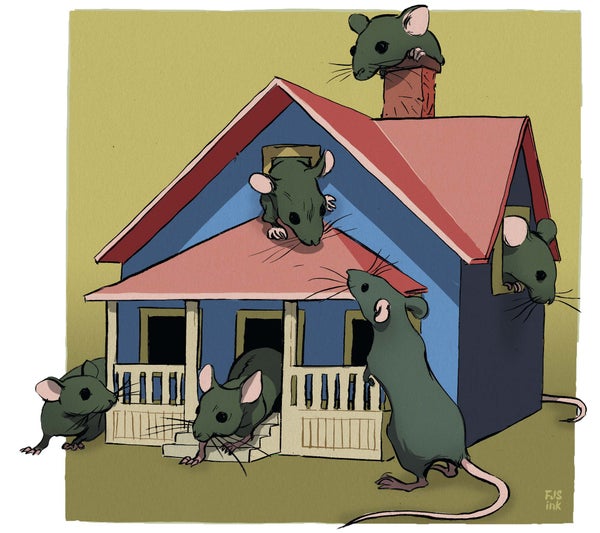
In the late 1950s the National Institute of Mental Health gave Calhoun the opportunity to manipulate rats in a remodeled Maryland barn. Calhoun, an endlessly inventive designer of experiments, built an enclosure outfitted with rat apartments and partitioned the pen into connected “neighborhoods,” creating a murid arcadia that he could observe at his leisure.
This utopia soon turned nightmarish. As the rats multiplied, they fed and gathered in ever greater densities, leading to a social breakdown that Calhoun called a “behavioral sink.” Packs of libidinous males relentlessly hounded females, who in turn ignored their offspring; in some neighborhoods, pup mortality hit 96 percent. The rats, Calhoun declared, suffered from “pathological togetherness” that could lead to collapse. In the years that followed, he shifted to mice, but his fundamental conclusions remained the same: rodents succumbed to chaos as their populations exploded.
Calhoun wasn’t shy about extrapolating to our own species’ fate. “Perhaps if population growth continues to grow unchecked in humans, we might one day see the human equivalent” of socially catatonic rodents, he told the Washington Daily News in one characteristic interview. His fears both channeled the zeitgeist and directed it.
Dugatkin—an evolutionary biologist, science historian and prolific author who sifted through thousands of pages at the Calhoun archive in Bethesda—is an admirably thorough researcher. But his granular chronology of Calhoun’s activities sometimes slides too deep into a recitation of media coverage, conference talks and intricate experiments. Amid this blizzard of minutiae, Mousery occasionally loses sight of a question that should be central to any biography: Why does Calhoun matter today? Dugatkin acknowledges that the “lasting impact of [Calhoun’s] work is nowhere near” that of pioneering behaviorists such as Ivan Pavlov. But he misses an opportunity to probe the social debates that his subject’s work catalyzed. Did Calhoun’s darker prognostications do harm? The population bomb, after all, failed to detonate.
Calhoun belonged to a generation of scientists who had no compunctions about straying from their disciplinary lane. He wrote poetry and sci-fi and consulted on humane prison design. Dugatkin captures the grand ambition of a man who gazed at rodents and saw the universe, even if the significance of his research is murky today. As Dugatkin notes, the disturbing dynamics that Calhoun produced in his micromanaged “universes” have never been observed in the wild. Calhoun didn’t describe the world; he created his own.
