On supporting science journalism
If you're enjoying this article, consider supporting our award-winning journalism by subscribing. By purchasing a subscription you are helping to ensure the future of impactful stories about the discoveries and ideas shaping our world today.
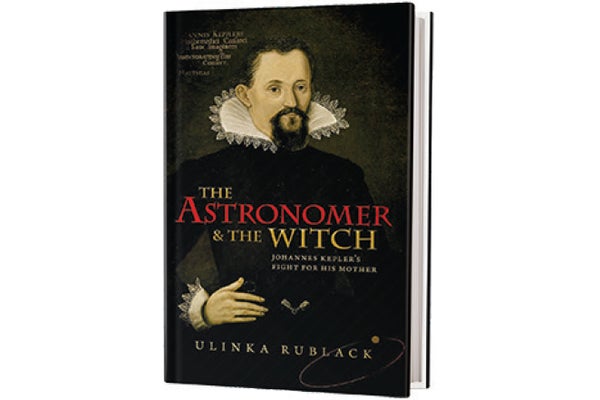
The Astronomer and the Witch: Johannes Kepler’s Fight for His Mother
by Ulinka Rublack
Oxford University Press, 2015 (($29.95))
Johannes Kepler was a renowned 17th-century German astronomer, mathematician, natural philosopher … and lawyer? Although he is not known for the last occupation, in 1620 he put his work on hold, packed up his household and moved back home to Württemberg, Germany, to defend his mother in court on charges of witchcraft. Historian Rublack uses the facts of the case to explore the intellectual, political and religious turmoil going on at that time in Europe, as well as the complexities of Kepler's own beliefs, which encompassed both scientific rationalism alongside the possibility of magic: while maintaining that witches did exist, he insisted that there was no evidence his mother was one. This surprising chapter in Kepler's life offers a window to better understand the famous genius and the world that created him.
Subscribe to Support Independent Journalism
Great science journalism requires human expertise, time, effort and creativity. And it costs money. That’s why I and the journalists here at Scientific American hope you’ll join our community.
When you subscribe, you are supporting staff and freelance journalists who are passionate about telling science stories that are true, important and compelling. Our editors and reporters are often experts in their fields, which means they understand the nuances of big discoveries and can untangle the breakthroughs from the hype. With a subscription, you are also supporting rigorous fact-checking to ensure the words we publish are precise and accurate. And you’re supporting original illustrations, graphics and photos that bring you closer to an advanced laboratory, an ice sheet in Antarctica or a space mission in orbit. You’re helping us craft other types of high-quality journalism as well: Our newsletters are carefully written, edited and curated by staffers you have or will come to know and love. Our Science Quickly podcast is based on original reporting, collaboration with editors and scientists and exacting production.
Subscriptions keep this engine running so we can continue to deliver thoughtful, rigorous and independent science journalism to you. In an era of viral misinformation, this work is crucial. If you value what we do, I hope you’ll consider joining us as a subscriber