
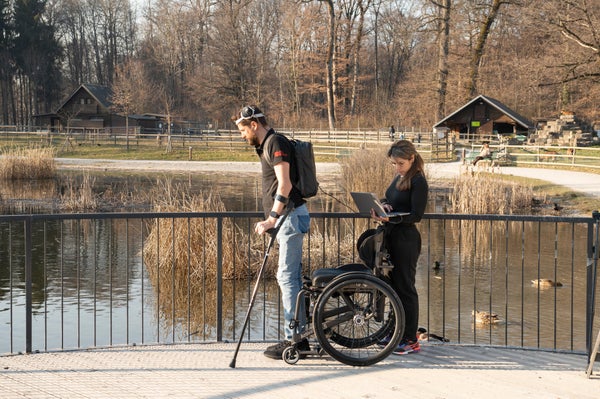
Twelve years ago, a cycling accident left Gert-Jan Oskam, now 40, with paralysed legs and partially paralysed arms, after his spinal cord was damaged in his neck. But these days, Oskam is back on his feet and walking, thanks to a device that creates a ‘digital bridge’ between his brain and the nerves below his injury.
The implant has been life-changing, says Oskam. “Last week, there was something that needed to be painted and there was nobody to help me. So I took the walker and the paint, and I did it myself while I was standing,” he says.
The device — called a brain–spine interface — builds on previous work by Grégoire Courtine, a neuroscientist at the Swiss Federal Institute of Technology in Lausanne and his colleagues. In 2018, they demonstrated that, when combined with intensive training, technology that stimulates the lower spine with electrical pulses can help people with spinal-cord injuries to walk again.
On supporting science journalism
If you're enjoying this article, consider supporting our award-winning journalism by subscribing. By purchasing a subscription you are helping to ensure the future of impactful stories about the discoveries and ideas shaping our world today.
Oskam was one of the participants in that trial, but after three years, his improvements had plateaued. The new system makes use of the spinal implant that Oskam already has, and pairs it with two disc-shaped implants inserted into his skull so that two 64-electrode grids rest against the membrane covering the brain.
When Oskam thinks about walking, the skull implants detect electrical activity in the cortex, the outer layer of the brain. This signal is wirelessly transmitted and decoded by a computer that Oskam wears in a backpack, which then transmits the information to the spinal pulse generator.
The previous device “was more of a pre-programmed stimulation” that generated robotic stepping movements, says Courtine. “Now, it’s completely different, because Gert-Jan has full control over the parameter of stimulation, which means that he can stop, he can walk, he can climb up staircases.”
“The stimulation before was controlling me and now I am controlling stimulation by my thought,” says Oskam. “When I decide to make a step, the simulation will kick in, as soon as I think about it.”
Enhanced rehabilitation
After around 40 rehabilitation sessions using the brain–spine interface, Oskam had regained the ability to voluntarily move his legs and feet. That type of voluntary movement was not possible after spinal stimulation alone, and suggests that the training sessions with the new device prompted further recovery in nerve cells that were not completely severed during his injury. Oskam can also walk short distances without the device if he uses crutches.
Bruce Harland, a neuroscientist at the University of Auckland in New Zealand, says that this continued improvement in spinal function is great news for anyone with a spinal-cord injury, “because even if it’s a longer-term chronic injury, there’s still a few different ways that healing could happen”.
“It’s certainly a huge jump” towards improved function for people with spinal-cord injuries, says neuroscientist Anna Leonard at the University of Adelaide in Australia. And, she says, there is still room for other interventions — such as stem cells — to improve outcomes further. She adds that although the brain–spine interface restores walking, other functions such as bladder and bowel control are not targeted by the device. “So, there’s certainly still room for other areas of research that could help progress improvements in outcomes for these other sort of realms,” she says.
Antonio Lauto, a biomedical engineer at Western Sydney University, Australia, says that less-invasive devices would be ideal. One of Oskam’s skull implants was removed after about five months because of an infection. Nevertheless, Jocelyne Bloch, the neurosurgeon at the Swiss Federal Institute of Technology who implanted the device, says that the risks involved are small compared with the benefits. “There is always a bit of risk of infections or risk of haemorrhage, but they are so small that it’s worth the risk,” she says.
Courtine’s team is currently recruiting three people to see whether a similar device can restore arm movements.
This article is reproduced with permission and was first published on May 24, 2023.