
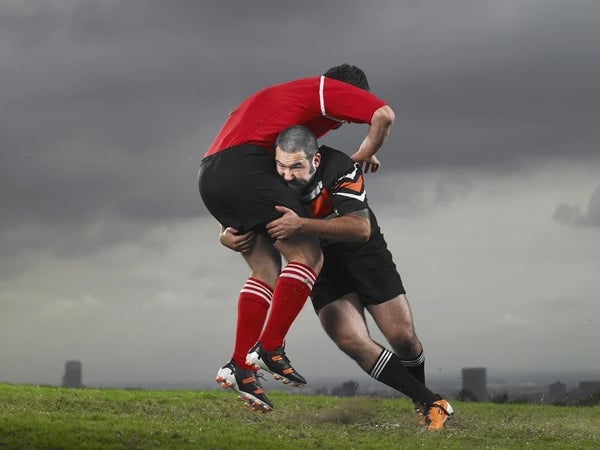
For decades, scientists have struggled to understand exactly how years of taking hits to the head while playing sports can translate into severe memory loss and dementia later in life.
Now, a study published today in Science Translational Medicine reveals that the protective shield known as the blood–brain barrier can be damaged and leaky decades after an athlete retires from sport. This persistent leakiness seems to trigger a long-lasting immune response that is closely tied to cognitive decline, the study finds.
The work is a “very important study that finds the disruption of the blood–brain barrier many years after head trauma,” says Katerina Akassoglou, a neuroimmunologist at the Gladstone Institutes in San Francisco, California, who was not involved in the research.
On supporting science journalism
If you're enjoying this article, consider supporting our award-winning journalism by subscribing. By purchasing a subscription you are helping to ensure the future of impactful stories about the discoveries and ideas shaping our world today.
Long-lasting damage
Part of the difficulty in studying the long-term effects of head trauma is that some neurodegenerative conditions, such as chronic traumatic encephalopathy (CTE), can be diagnosed only by examining neuronal tissue after death, says Matthew Campbell, a specialist in neurovascular genetics at Trinity College Dublin, who co-authored the paper.
Campbell and his colleagues wanted to see whether they could spot warning signs in living athletes by looking at the blood–brain barrier, a dense layer of cells lining the blood vessels that supply the brain. This layer usually keeps harmful substances from leaking out of the blood and into brain tissue.
To investigate, the researchers scanned the brains of 47 athletes who had retired from playing contact sports with a high risk of concussion and repetitive head impact, such as rugby and boxing. They also examined a control group of non-athletes and athletes who had played non-contact sports.
The brain scans showed that the blood–brain barriers of the contact-sport athletes were significantly leakier than were those of people in the control group, even though the athletes had been retired for an average of 12 years at the time of the study. People with the most extensive barrier damage performed worse than did those with less extensive leakiness on memory and cognitive tests, the researchers found.
“This was the first evidence in the living human brain that the blood–brain barrier is disrupted in individuals likely to have CTE,” Campbell says.
Difficult diagnosis
Standard blood tests used to spot brain damage were not very effective at identifying those experiencing cognitive decline, the researchers found. Instead, the warning signs became visible only after the team examined the athletes’ immune systems: the blood of people with the most barrier damage and greatest cognitive decline contained a higher proportion of inflammatory white blood cells and other biomarkers of immune activation than did the blood of those with less-extensive damage. “It looked like the athletes were living systemically in a hyper-inflamed state,” Campbell says.
The discovery suggests that brain scans detecting leaky vessels could one day serve as a tool for identifying living patients at high risk of severe brain diseases, the authors write. It also gives scientists a potential target for developing treatments to prevent this type of neurodegeneration.
These results shouldn’t dissuade people from organized physical activities, Campbell says. “Playing sports is incredibly healthy for the brain,” he says. “This type of damage we see is from prolonged exposure — it’s the cumulative nature of head trauma that is worrying.”
Next, the researchers hope to replicate their findings in a larger population. Campbell says that the study included few females — only seven of 62 athletes and control participants combined — because, for now, there are many fewer retired elite female athletes than male athletes.
This article is reproduced with permission and was first published on March 18, 2026.