
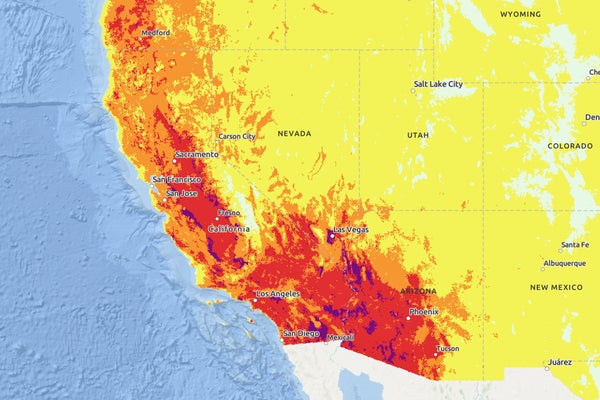
For the past 100 days in Phoenix, Ariz., the temperature has risen to—and often well above—100 degrees Fahrenheit (37.8 degrees Celsius). In this city and much of the heat-weary Southwest, that streak will last at least a few more days as yet another heat dome settles over the area and sends temperatures soaring.
The heat wave punctuates what has been a record-hot summer for parts of the Southwest, including the major cities of Phoenix and Las Vegas–one that has toppled the previous records for the hottest meteorological summer set in those cities just last year. “It’s kind of rare to see that happen two years in a row,” says Matt Salerno, a meteorologist at the National Weather Service’s (NWS’s) Phoenix office. “That’s quite the feat.” It’s even more startling that the city broke its record from last year by nearly two degrees F (one degree C), with an average temperature of 98.9 degrees F (37.2 degrees C). “That’s incredible, just to think of the average temperature that we’re living in here in Phoenix,” Salerno says.
Las Vegas has also set records by “just about any metric you look at,” says Matt Woods, a meteorologist at the NWS’s Las Vegas office. “It’s been brutal.”
On supporting science journalism
If you're enjoying this article, consider supporting our award-winning journalism by subscribing. By purchasing a subscription you are helping to ensure the future of impactful stories about the discoveries and ideas shaping our world today.
In both cities, the tenor of the heat has been a little different this summer compared with that of last summer. The Southwest started off with a mild June last year, followed by a July that was off the charts, and then things cooled down again late in August when Hurricane Hilary stormed through. This summer hasn’t reached the same peaks as July 2023, but it has been steadily scorching from the jump. In Las Vegas, “we only had six days this summer that had a high temperature below 100 [degrees F],” Woods says. Meanwhile Phoenix’s streak of 100-degree-F days has completely blown past the city’s previous record of 76 such consecutive days, which was set in 1993.
The record-breaking heat of both summers has come from a series of heat waves where masses of hot air that park over an area for days. “We’ve basically had that for the overwhelming majority of the summer,” Woods says. The clear skies that accompany these features mean “land surfaces heat up day after day,” which in turn heats up the air just above the surface, Salerno says. Such heat waves are happening more frequently, lasting longer and becoming more intense because of the excess heat trapped by greenhouse gases that have been generated by burning fossil fuels.
This week’s heat wave won’t be as intense as the one that suffocated the region in July, and it won’t last as long, “but it’s definitely unusual for this time of year,” Woods says. It is extending the amount of time residents are being subjected to conditions that bring a serious risk of illness. “Just because the temperatures aren’t what we saw in July doesn’t meant they aren’t dangerous,” Woods says. In the U.S., extreme heat is deadlier than hurricanes, floods and tornadoes combined.
Those at particular risk of heat exhaustion, heat stroke and other heat-related health problems include very young children, older people, those who have certain existing health conditions or are on particular medications, people who work outside and unhoused individuals. Both Woods and Salerno emphasize the need for all people in any heat wave to stay hydrated, avoid going outside during the peak heat of the day, and seek out shade or air-conditioning when at all possible. Both scientists also warn that people should never leave a child or pet unattended in a car; so far this year, 27 children have died of heat stroke after being left in a vehicle.
“Essentially all heat-related deaths are preventable,” says Kristie Ebi, an epidemiologist who specializes in heat-related health risks. Many cities, including Phoenix, are looking for ways to better warn residents and to reduce deaths and hospitalizations from heat-related illness. The NWS has also been working on better warning practices, including a new experimental tool called HeatRisk that shows locations where heat will be extreme enough to represent a serious health concern.
Though the heat of the day can pose a clear and obvious risk, both Salerno and Woods emphasize that warm nights are an underappreciated threat because they don’t allow the body time to sufficiently cool down. “Everyone likes to look at the high temperatures,” Woods says, but “it’s really the low temperatures that are the silent killer.”
The average overnight low in Phoenix this summer has been 87.5 degrees F (30.8 degrees C)—which beats last summer’s average low of 84.8 degrees F (29.3 degrees C). During this year’s season, there have been 37 days in which the overnight low was at or above 90 degrees F (32.2 degrees C), Salerno says. “Our low temperatures are most places’ high temperatures,” he adds.
And now September is extending this danger and misery, already starting “way above where we should be for this time of year,” Salerno says. Temperatures in Phoenix and the surrounding area could reach above 110 degrees F (43.3 degrees C), and it’s likely this event will push the city past last year’s record of 55 total days with a high of 110 degrees F or higher.
It’s possible that heat could even extend into next week. Last year the final day of 110-degree-F weather in Phoenix was September 10, 2023. (The city’s record latest 110-degree day in a given year was September 19, 2010.) “I hope this is it for the 110-degree heat,” a weary-sounding Salerno says.