
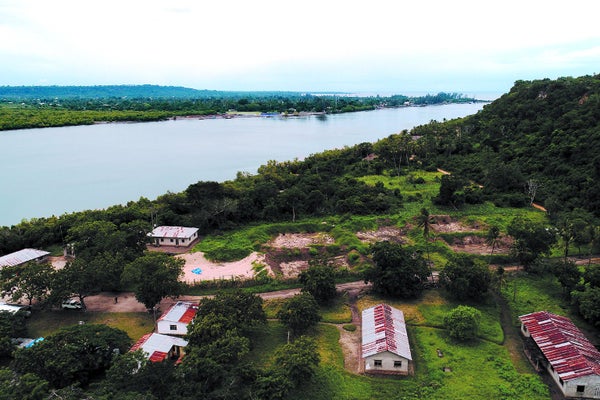
The 2004 Indian Ocean earthquake sent a tsunami surging outward from Sumatra, devastating coastlines across Southeast Asia but doing much less damage by the time it reached Africa. Many scientists have since considered the tsunami risk in parts of East Africa to be relatively low. But new research conducted on a 1,000-year-old sand layer full of human bones, in northeastern Tanzania's Pangani Bay, puts the threat of a monster wave back in the spotlight.
Supplementing years of fieldwork done by archaeologists at the University of Dar es Salaam, an international group of geologists combined its own sand-layer analysis with computer-simulated earthquake scenarios. The group found evidence that an ancient Pangani Bay fishing settlement was wrecked by a tsunami emanating from the Sumatra-Andaman subduction zone—which was also the source of the powerful 2004 tsunami. Lead author Vittorio Maselli of Dalhousie University in Nova Scotia was a National Geographic Explorer for the study, published online in May in Geology. Within the sand layer the researchers found evidence of tiny marine fauna swept in from the sea and broken human bones that could not be attributable to disease, violence or traditional burials. “Taking the analysis together, the tsunami was the best interpretation,” Maselli says.
This study could provide the first in a series of data points needed to understand the extent of tsunami risk along East Africa's vast coastline of unmapped seafloors and buried sand layers. And it matches evidence elsewhere: on the other side of the Indian Ocean, researchers have spotted similar tsunami deposits thousands of years old in many of the coastal areas that suffered the heaviest casualties from the 2004 event. “Perhaps the most interesting part [of this study] is that it correlates well with what some of my colleagues had done on the eastern coast of India,” says Emile Okal, a seismologist at Northwestern University, who was not involved in the new research. “From a geologic standpoint, I think this is a very nice contribution.”
On supporting science journalism
If you're enjoying this article, consider supporting our award-winning journalism by subscribing. By purchasing a subscription you are helping to ensure the future of impactful stories about the discoveries and ideas shaping our world today.
Although more work is needed to fully understand the area's risk, the researchers say their study identifies a very real natural hazard for developers to consider in this rapidly urbanizing region. “To me, the takeaway is for long-term infrastructure projects,” says Andrew Moore, a study co-author and a geologist at Earlham College. “This is a call to arms to go look” for tsunami deposits elsewhere.
Additional research can help future East African megacities mitigate risk, Maselli says: “For the moment our knowledge is just one point for the entire African continent. Our claim is, ‘Look, we found something ... let's go back to East Africa and learn more.'”