
Chinese tech giant ByteDance on Monday launched an AI voice assistant for smartphones that can act autonomously on the user’s behalf.
The assistant, powered by ByteDance’s Doubao large language model, calls to mind the AI at the center of the film Her, in which the protagonist falls in love with the voice in his phone.
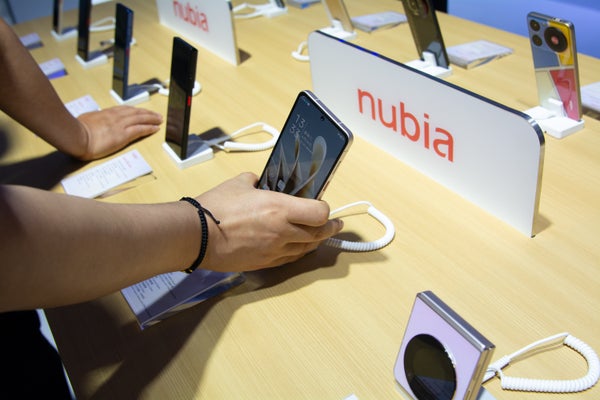
The AI can open tabs, book tickets and search the phone for information. It will be available on the M153 Nubia handset, although only in limited quantities. ByteDance plans to license the tool to other Chinese smartphone makers, according to the Chinese financial platform Eastmoney.
On supporting science journalism
If you're enjoying this article, consider supporting our award-winning journalism by subscribing. By purchasing a subscription you are helping to ensure the future of impactful stories about the discoveries and ideas shaping our world today.
The Doubao LLM is the most popular AI chatbot in China. Deployed on the phone, it runs at the operating-system level, enabling the AI to see what’s on the screen and use apps, executing tasks like pulling and organizing files, filling in forms and even suggesting restaurants that match budget and preferences.
The assistant also has memory, allowing it to store information on the device—meeting notes, addresses, a child’s age and preferences—and turn them into reminders or to‑do items. Users can ask questions like “Which seat was I in on last week’s train?” or “Where was that café I liked near the office?”
It’s a leap up from older voice assistants such as Apple’s Siri, which operate in such a way that the responses can suffer from a lag and a lack of emotional nuances. In these systems, speech is recorded, turned into text and sent to a server for analysis, and the response is then read aloud by a separate text-to-speech tool. ByteDance’s AI, by contrast, uses a speech-to-speech system that allows for faster answers and even for the user to interrupt the assistant mid‑sentence—much in the same the way you might interrupt a friend or a co-worker.
According to Guangdong Yangcheng Evening News, Doubao’s updated voice calls are nearly “indistinguishable from a human” when it comes to realism and emotions such as joy and sadness. Still, ByteDance caveated that the tech is still in beta and requires further testing before it is rolled out more widely.
Is this the Her moment tech and science-fiction enthusiasts have been waiting for? In San Francisco, Beijing, Seoul and Cupertino, engineers are chasing the same goal: an AI assistant that listens, understands and acts without making you think about the software in between. ByteDance’s Doubao phone assistant suggests how quickly that future is approaching.
Similar technology exists in the U.S. OpenAI’s GPT‑4o, introduced in 2024, also supports real-time conversations, and Google’s Gemini Live mode can also offer real‑time, interruptible voice chats on phones. And AI assistant apps are getting increasingly good at doing tasks such as summarizing calls and e-mails, translating, booking appointments and drafting replies. But a major difference between these features and Doubao is that it is a Chinese-made AI being fully embedded into a Chinese-made smartphone, specifically for the Chinese market.