
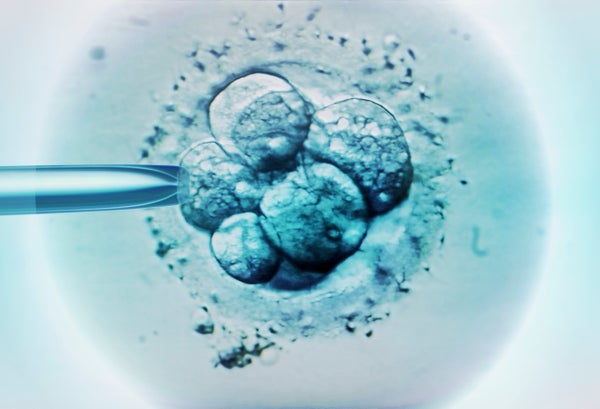
Fertility companies are betting on artificial intelligence and other technologies to boost the chances of a successful IVF pregnancy. By itself, IVF is a revolutionary reproductive technology. For more than 40 years, it has enabled millions of people who might not otherwise have been able to have children to become parents. In 2024 more than 100,000 babies were born in the U.S. through IVF. But some fertility experts believe frontier AI could further boost the odds of a successful pregnancy.
IVF’s favorable outcomes vary from person to person; in 2022 the percentage of successful reproductive technology-assisted births was 37.5 percent across all age groups but the likelihood drops to around 10 percent or lower for people over 40, according to the U.S. Centers for Disease Control and Prevention. AI proponents argue that the technology could help better predict successful pregnancies and scan embryos for quality and genetic conditions that might affect the chance of a successful birth. Not all experts are so optimistic, however.
Some researchers argue that AI-powered embryo screening, especially for observable traits such as height or eye color, poses deep ethical questions. And it is unclear whether AI tools carry less risk than existing genetic testing protocols, or if they might even introduce new ones—such as threats to data privacy. “Just as society at large is grappling with these questions about a framework for AI, I think [assisted reproduction providers] need to do the same,” says Mina Alikani, a clinical embryologist and reproductive medicine expert.
On supporting science journalism
If you're enjoying this article, consider supporting our award-winning journalism by subscribing. By purchasing a subscription you are helping to ensure the future of impactful stories about the discoveries and ideas shaping our world today.
Still, AI is already making a mark on IVF, particularly in how morphology-based embryo selection is done. Clinical applications of deep learning are being used to assess whether a gamete’s morphology will contribute to successful fertilization or to screen embryos for specific appearances and other traits, including intellectual disability.Typically, an embryologist inspects embryos produced through IVF and assesses their quality. But AI might do better: a 2023 review found that AI models can more accurately predict which embryo will lead to a successful pregnancy (but not necessarily a live birth) than embryologists—with 81.5 percent and 51 percent accuracy, respectively.
Fertility clinics are taking note. Some AI platforms, such as Cercle, are training models on collected hormonal, physiological and sperm motility data from IVF procedures, and a program trained on these data may be able to better predict whether a given egg and sperm will lead to a successful pregnancy. According to fertility startup Herasight, AI could help “make that uncertainty more understandable. By combining large datasets from sources such as HFEA, SART, and the clinical literature, we can model how many eggs, blastocysts, euploid embryos, and ultimately live births a patient is realistically likely to get.”
A small randomized controlled trial from 2025 found that AI was just as good as, if not better than, traditional embryo selection methods. Still, based on the current literature, “AI systems show promise in assisting with egg, embryo and sperm selection, but they are not yet consistently validated to improve clinical outcomes or to replace embryologists’ judgment,” Alikani says
What’s also true is that our knowledge of AI’s performance in assisted reproductive technology remains limited. There are just a handful of randomized controlled trials testing its efficacy in improving IVF outcomes. Because data collection procedures are constantly changing and vary from country to country—and even clinic to clinic— it’s hard to synthesize a large dataset to help standardize an AI-powered embryo grading system.
“It's a Tower of Babel,” says David Sable, a reproductive endocrinologist and adjunct faculty member at Columbia University. In a 2025 paper, Alikani and her colleague outlined how standardizing automation technologies across laboratories and clinics could improve IVF success rates. And in another 2025 review, a team of scientists argued that precision needs to be the guiding principle of using AI in IVF: “Personalization of ovarian stimulation protocols, gamete selection, and embryo annotation and selection are critical areas where AI may benefit significantly,” the authors wrote. But they also warned that it is still too early to say if the technology is working: “AI's integration into IVF holds promise for advancing patient care, but its clinical potential requires careful evaluation and ongoing refinement.”
Another challenge for AI-assisted IVF is that reproductive technology is relatively young compared with other, more established medical practices, such as bacteriology. “IVF is somewhat of an immature procedure and certainly an immature industry; it’s usually available to a tiny number of people,” says Sable. A single cycle of IVF can cost as much as $50,000; that shapes who has access to fertility treatment and which procedures they might opt for.
Sable also argues that if researchers use patient data sets to train new AI programs, they must be anonymized so that “they can’t be used for the wrong purposes.” Health data breaches can undermine patient privacy and cost the healthcare industry billions to clean up. And AI models can also hallucinate, making mistakes and even producing fabricated data.
Other technologies now used as part of IVF suggest that AI could soon become more integrated, despite its potentially small effect on the success of pregnancy and birth. For example, intracytoplasmic sperm injection (ICSI) is a specialized form of IVF in which time-lapse images of sperm moving in a petri dish help clinicians select those believed to be most likely to fertilize an egg. Although this system has become standard in many IVF procedures, a 2024 trial in the UK and Hong Kong that included nearly 1,600 participants found that the percentage of live births with time-lapse imaging was 33.7 percent, compared with 33 percent without it—a negligible difference.
More effective is preimplantation genetic testing for aneuploidy (PGT-A), a diagnostic screening that checks embryos for chromosomal abnormalities. The procedure has been associated with a higher number of live births, Sable says.
IVF’s success rates remain at most 50 percent—but are usually lower, even in the best of circumstances, says Alikani. That is why so many fertility clinics are leaning into AI—to try to improve those chances. “There is a possibility that we will get [to above 50 percent] in a shorter time than we can expect or imagine” by using AI, she says. “But at the moment, the evidence does not show that applying AI algorithms is giving us superior results.”