
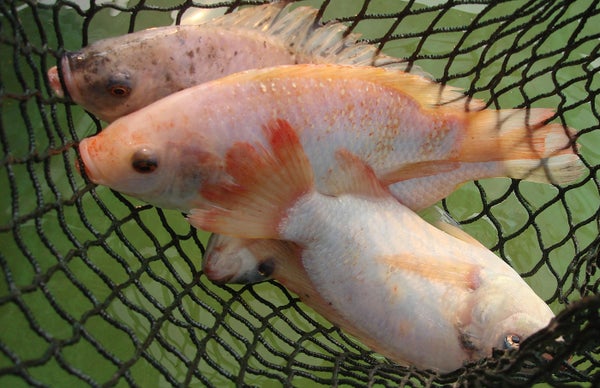
FORTAZELA, Brazil — In this historic city by the sea in northeast Brazil, burn patients look as if they’ve emerged from the waves. They are covered in fish skin — specifically strips of sterilized tilapia.
Doctors here are testing the skin of the popular fish as a bandage for second- and third-degree burns. The innovation arose from an unmet need. Animal skin has long been used in the treatment of burns in developed countries. But Brazil lacks the human skin, pig skin, and artificial alternatives that are widely available in the US.
The three functional skin banks in Brazil can meet only 1 percent of the national demand, said Dr. Edmar Maciel, a plastic surgeon and burn specialist leading the clinical trials with tilapia skin.
On supporting science journalism
If you're enjoying this article, consider supporting our award-winning journalism by subscribing. By purchasing a subscription you are helping to ensure the future of impactful stories about the discoveries and ideas shaping our world today.
As a result, public health patients in Brazil are normally bandaged with gauze and silver sulfadiazine cream.
“It’s a burn cream because there’s silver in it, so it prevents the burns from being infected,” said Dr. Jeanne Lee, interim burn director at the the regional burn center at the University of California at San Diego. “But it doesn’t help in terms of debriding a burn or necessarily helping it heal.”
The gauze-and-cream dressing must be changed every day, a painful process. In the burn unit at Fortaleza’s José Frota Institute, patients contort as their wounds are unwrapped and washed.
Enter the humble tilapia, a fish that’s widely farmed in Brazil and whose skin, until now, was considered trash. Unlike the gauze bandages, the sterilized tilapia skin goes on and stays on.
The first step in the research process was to analyze the fish skin.
“We got a great surprise when we saw that the amount of collagen proteins, types 1 and 3, which are very important for scarring, exist in large quantities in tilapia skin, even more than in human skin and other skins,” Maciel said. “Another factor we discovered is that the amount of tension, of resistance in tilapia skin is much greater than in human skin. Also the amount of moisture.”
In patients with superficial second-degree burns, the doctors apply the fish skin and leave it until the patient scars naturally. For deep second-degree burns, the tilapia bandages must be changed a few times over several weeks of treatment, but still far less often than the gauze with cream. The tilapia treatment also cuts down healing time by up to several days and reduces the use of pain medication, Maciel said.
Antônio dos Santos, a fisherman, was offered the tilapia treatment as part of a clinical trial after he sustained burns to his entire right arm when a gas canister on his boat exploded. He accepted.
“After they put on the tilapia skin, it really relieved the pain,” he said. “I thought it was really interesting that something like this could work.”
The initial batches of tilapia skin were studied and prepared by a team of researchers at the Federal University of Ceará. Lab technicians used various sterilizing agents, then sent the skins for radiation in São Paulo to kill viruses, before packaging and refrigerating the skins. Once cleaned and treated, they can last for up to two years.
In the US, animal-based skin substitutes require levels of scrutiny from the Food and Drug Administration and animal rights groups that can drive up costs, Lee said. Given the substantial supply of donated human skin, tilapia skin is unlikely to arrive at American hospitals anytime soon.
But it may be a boon in developing countries.
“I’m willing to use anything that might actually help a patient,” Lee said. “It may be a good option depending on what country you’re talking about. But I also think the problem is that you need to find places that have the resources to actually process the skin and sterilize it, and make sure it doesn’t have diseases.”
In Brazil, in addition to the clinical trials, researchers are currently conducting histological studies that compare the composition of human, tilapia, pig, and frog skins. They are also conducting studies on the comparative costs of tilapia skin and conventional burn treatments. If clinical trials show continued success, doctors hope a company will process the skins on an industrial scale and sell it to the public health system.
Republished with permission from STAT. This article originally appeared on March 2, 2017