
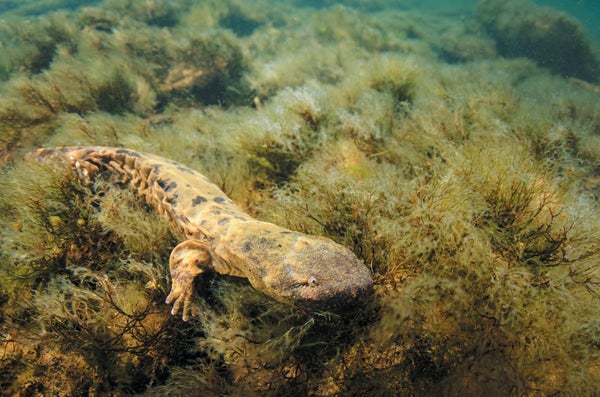
Male hellbender salamanders usually make doting dads, guarding eggs and shaking them free of silt. But in some troubled populations, they are cannibalizing their entire brood every year, further jeopardizing the vulnerable giant salamander species.
Eastern hellbenders once swam in at least 570 streams in the eastern and central U.S., says Bill Hopkins, an ecologist at Virginia Tech. But numbers of the craggy, beady-eyed amphibians have plummeted in recent decades, with only about 126 streams now harboring healthy populations—and scientists didn't know why.
To solve the mystery, Hopkins's team placed hundreds of concrete nest boxes in streams in southwestern Virginia. For eight years they snooped on 182 nests, checking them every few days during the breeding season. In 60 percent of those nests not a single larva survived, most commonly because of whole-clutch cannibalism: the male had gobbled up hundreds of eggs. These cannibal dads had bulging bellies and a tendency to regurgitate the eggs when handled, the team reported in the American Naturalist.
On supporting science journalism
If you're enjoying this article, consider supporting our award-winning journalism by subscribing. By purchasing a subscription you are helping to ensure the future of impactful stories about the discoveries and ideas shaping our world today.
The researchers' documentation of egg survival rates across time is “incredibly impressive,” says Hope Klug, a behavioral ecologist at the University of Tennessee at Chattanooga, who wasn't part of the study. Cannibalism of offspring isn't unusual among animals, Klug says, explaining that parents may nutritionally benefit from consuming some offspring that they suspect won't survive. And desperately hungry parents in some species may eat their young during lean times, banking on reproducing later. Changes to the hellbenders' environment may have turned this once beneficial adaptation into a harmful evolutionary trap, Klug says.
Deforestation of the salamanders' woodland habitat may be to blame, the study findings suggest. Whole-clutch cannibalism was three times more common in areas with low upstream forest cover than in those with greater coverage. Vegetation helps to prevent streambank erosion, keeping back salt-filled silt that changes the water chemistry and fills the gaps between gravel—where hellbender larvae live. Trees also shade the streams, keeping the water cooler and more oxygen-rich.
Cannibalism isn't the only human-influenced cause of death threatening hellbender populations; anglers sometimes snag adults, and a silt-filled habitat itself can harm larvae. “This is a species that's been around for millions of years,” surviving the extinction event that wiped out the dinosaurs, Hopkins says. “And now we humans are driving it to extinction.”
Restoring forest cover and putting in protections around streams will take decades, Hopkins says. In the short term, conservationists could keep the numbers up by rearing hellbender larvae for release and avoiding this danger at the nest.