
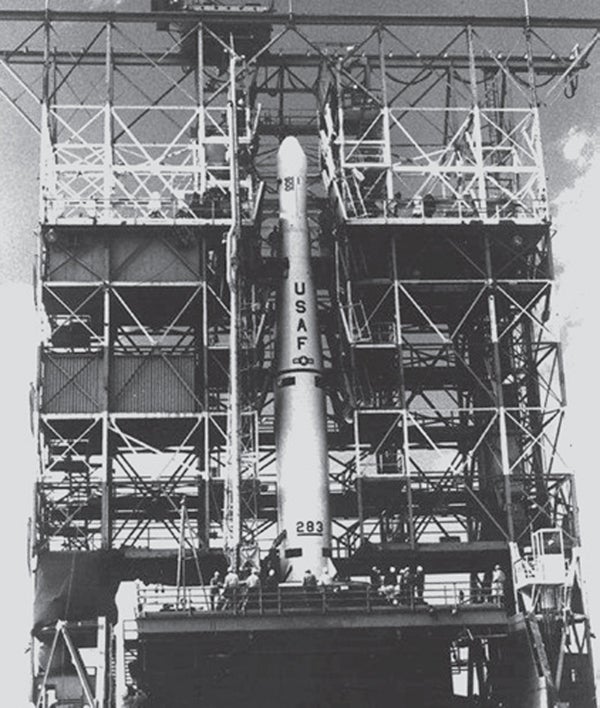
Sixty years ago the U.S. Air Force repurposed its Thor missile as a launch vehicle to put small scientific, weather and military satellites into orbit. Or at least that was the plan. Many of those early satellites ended up in the ocean, along with the remnants of wayward rockets that blew up before reaching space. These vehicles include a Thor Able Star booster that lifted off with a U.S. Navy navigation satellite from Florida's Cape Canaveral Air Force Station on November 30, 1960, and then headed southeast along an unusual flight path.
Rockets launching from the U.S. East Coast usually aim to put satellites in orbits relatively close to the equator; these orbits are within easy reach from Cape Canaveral. But this satellite was set to loop around Earth's poles, a desirable trajectory to view the whole planet that requires much more launch power from Florida to overcome Earth's rotational spin. “Polar orbits are just very difficult to do from this area,” says Roger McCormick, a historian at the Cape Canaveral Air Force Space & Missile Museum.
The launch failed and showered debris over Cuba, sparking a cold war confrontation when Cuba claimed falling wreckage killed a cow. A CIA retrospective says Fidel Castro's government paraded another cow through the streets of Havana with a placard addressing the American president: “Eisenhower, you murdered one of my sisters.” Lore aside, Florida polar launches were suspended, and the U.S. Air Force later dismantled its ground stations with the capability to remotely track rockets on that path.
On supporting science journalism
If you're enjoying this article, consider supporting our award-winning journalism by subscribing. By purchasing a subscription you are helping to ensure the future of impactful stories about the discoveries and ideas shaping our world today.
Now, however, U.S. officials are reopening the route, thanks to a new generation of rockets that carry along their own flight-tracking systems. These systems can autonomously trigger self-destruct signals should the booster fly off course.
Private company SpaceX aims to launch the first such mission, to put an Argentine Earth-observing satellite into polar orbit, later this year. SpaceX's Falcon 9 rocket will still fly over Cuba, but by then its high-energy first stage will have separated; the second stage will propel the spacecraft roughly 490 kilometers above the island, Federal Aviation Administration officials say. Rockets heading east from Cape Canaveral typically conduct second-stage flight over land as well—so this polar flight is not considered a higher risk to public safety, says Wayne Monteith, who heads the FAA's Commercial Space Transportation office.
SpaceX is looking to eventually fly as many as seven polar-orbiting missions a year from Florida, and other launch operators are watching. “Once you had a company that could successfully demonstrate it,” Monteith says, “you would anticipate other companies may follow suit.”