
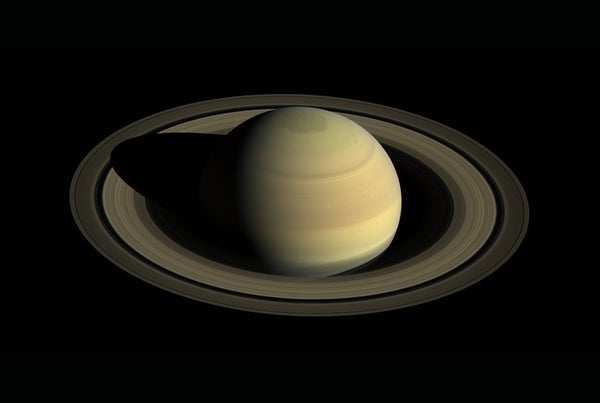
NASA's Cassini spacecraft begins a series of daring dives through Saturn's rings Nov. 30, the first step in the probe's "grand finale" investigation of the gas giant planet.
From Nov. 30 to April 22, Cassini will dive through the outer edge of Saturn's rings 20 times, once every seven days. The spacecraft will be entering uncharted territory, getting the closest look ever at Saturn's outer rings and its moons. NASA described this phase of the mission in a new video.
"We're calling this phase of the mission Cassini's Ring-Grazing Orbits, because we'll be skimming past the outer edge of the rings," Linda Spilker, Cassini project scientist at NASA's Jet Propulsion Laboratory (JPL) in California, said in a statement. "In addition, we have two instruments that can sample particles and gases as we cross the ring plane, so in a sense, Cassini is also 'grazing' on the rings." [Saturn's Hexagon, Rings and More 'Stared at' for Days - Cassini Time-Lapse Video]
On supporting science journalism
If you're enjoying this article, consider supporting our award-winning journalism by subscribing. By purchasing a subscription you are helping to ensure the future of impactful stories about the discoveries and ideas shaping our world today.
This isn't the first time Cassini has broken new ground. Over its 12 years in Saturn's system, the probe has dropped a lander on Saturn's moon Titan, discovering the satellite's methane seas; discovered an underground ocean on the moon Enceladus; and investigated the origins of Saturn's strange,giant hexagonal jet stream. (Plus, Cassini discovered multiple new moons around Saturn.)
Cassini left for Saturn in 1997, taking a complicated path past Venus twice, Earth and then Jupiter to build up speed before reaching the ringed planet's system in 2004.
Cassini will pass through a faint outer ring for a few orbits, and then probe the outer reaches of Saturn's F ring, which marks the boundary of the main ring system. The F ring is about 500 miles (800 kilometers) wide—narrow compared to other rings—and features constantly changing streamers, filaments and dark channels that change over the course of hours, NASA researchers said in the statement.
"Even though we're flying closer to the F ring than we ever have, we'll still be more than 4,850 miles (7,800 km) distant." Earl Maize, Cassini project manager at JPL, said in the statement.
While there, Cassini will explore the many small moons orbiting within and near the rings (including Pandora, Atlas, Pan and Daphnis), scoop up ring particles and gas to analyze, and build an in-depth scan of the rings' structure.
After the mission phase ends in April, Cassini will begin the "Grand Finale" proper, slinging around the moon Titan to begin 22 dives between Saturn and its rings, and finally turning to dive into the planet's atmosphere on Sept. 15. Researchers will use observations of the planet during this ring-grazing phase of to calculate how close the spacecraft can safely go during its dives before the final plunge, the scientists said.
That final dive will not only keep the spacecraft, running out of fuel, from contaminating Saturn's potentially habitable moons, but it will also provide an unprecedented view of the planet's gravity, composition and atmosphere.
Copyright 2016 SPACE.com, a Purch company. All rights reserved. This material may not be published, broadcast, rewritten or redistributed.