
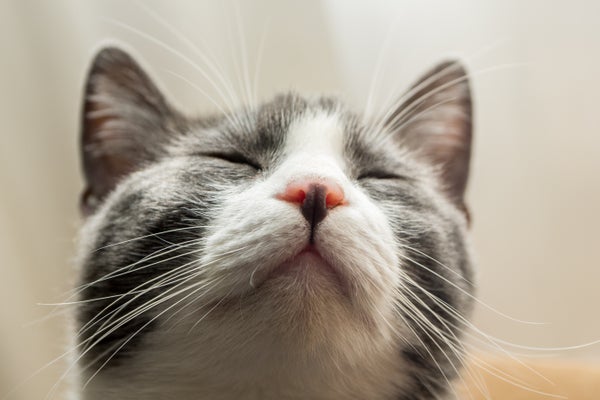
When it comes to a keen sense of smell, dogs get all the glory. But cats have a pretty well-developed sniffer, too—and a new study may explain how it works.
Researchers created a computational model of a cat’s nose based on computed tomography scans and tissue slices from a deceased house cat whose body was donated for research. When a cat takes a sniff, airflow is diverted into two different streams for breathing and smelling. The model showed that the animal’s nasal passages then direct the smelling stream through an extensive network of tightly coiled, sensor-studded channels called turbinates. The scientists hypothesize that this structure may function like a gas chromatograph—a sophisticated chemical device that separates different compounds based on their solubility. Scents that dissolve less easily in nasal mucus travel farther than more readily dissolved ones and therefore bind to more distant smell receptors.
“We know that animals—including cats—use a sense of smell for detection of food, for sense of danger and also for kin recognition,” says Kai Zhao, a bioengineer in the department of otolaryngology at the Ohio State University and senior author of the study. The coiled structure the researchers documented is more than 100 times more efficient than the straight channel found in the noses of amphibians and some mammals, and it can fit more smell receptors in a confined head space, Zhao notes. The study was published on Thursday in PLOS Computational Biology and was partially funded by Mars Petcare UK, a company that manufactures pet food.
On supporting science journalism
If you're enjoying this article, consider supporting our award-winning journalism by subscribing. By purchasing a subscription you are helping to ensure the future of impactful stories about the discoveries and ideas shaping our world today.
“What they show is that this turbinate structure seems to be very highly complex in cats, compared to other species of mammals,” says Luis Saraiva, a smell neuroscientist at Sidra Medicine in Qatar, who was not involved with the study. The most surprising part, he adds, is that cats “have a lot more of those turbinates, compared to rats or humans.”
This is not the first time the gas chromatograph analogy has been used for nasal anatomy. The idea was initially proposed in the 1960s, but most of the studies that explored it were in amphibians, which have a much simpler nasal structure. Previous investigations have shown that other exquisite smellers, including dogs, rats and bobcats, have a nose with coiled turbinates, but the new paper is the first to study the arrangement in house cats and extend the gas chromatograph analogy to mammals.
Cats’ nasal sensitivity might also explain why they make the characteristic “stinky face” when they smell something unpleasant. Like humans smelling milk that has gone off, they may be trying to close up their nasal passages to avoid inhaling the scent too deeply, Saraiva speculates.
“The next big step is trying to link computational studies like this with real physiological studies in animals,” says Tom Eiting, a physiologistat Burrell College of Osteopathic Medicine who has studied olfaction in bats and wasn’t involved in the new paper. Ultimately, he says, researchers hope to map the solubility of various scents to the locations of specific smell receptors in cats’ noses.
The complexity of the animals’ nasal structure underscores how sophisticated their sense of smell is. But don’t expect them to replace dogs as bomb sniffers anytime soon. “Cats are very difficult to train,” Zhao says.