
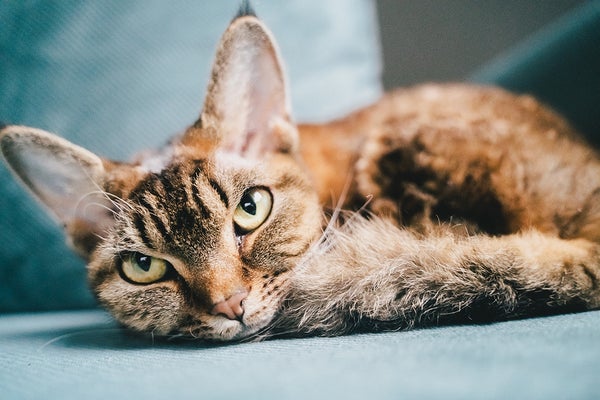
Pop culture holds that if you’re trapped in a well, Lassie will lead the way to a rescue—but if you’re stuck with Garfield, you’d better have some lasagna in your pocket. And research suggests such stereotypes aren’t far off.
Scientists compared 19 children between 16 and 24 months old with 38 untrained pet dogs and 22 cats, asking a simple question: Who will spontaneously respond when a human appears to need help? In the experiment, a familiar caregiver—the child’s parent or the pet’s owner—interacted with a sponge before turning away. Then an experimenter hid it in full view of the study subject. Across three trials of decreasing difficulty—when the sponge was unreachable and covered, then visible but out of reach, then fully reachable—the person searched, repeating, “I can’t find it. What should I do?” but never directly addressing the subject.
The study grew out of a broader question about prosocial behavior—why some species help others and some don’t, says comparative ethologist and study co-author Melitta Csepregi, who studies animal behavior at ELTE Eötvös Loránd University in Hungary. “To get at that, we compared dogs, cats and toddlers, three species that live closely with humans but differ sharply in their evolutionary histories.”
On supporting science journalism
If you're enjoying this article, consider supporting our award-winning journalism by subscribing. By purchasing a subscription you are helping to ensure the future of impactful stories about the discoveries and ideas shaping our world today.
In the findings described in Animal Behaviour, all three groups paid similar levels of attention. But children and dogs were more likely to show helping-related behaviors—approaching, indicating or retrieving the object for the person. By the final trial, more than half the dogs and nearly half the toddlers indicated the object’s location, and some also brought it to the caregiver. Cats never approached it and only rarely indicated its location.
University of Vienna cognitive biologist Ludwig Huber, who was not involved in the study, says that “the authors made considerable efforts to rule out alternative explanations [for dogs’ motivation] such as attention, eye contact, object interest, and getting used to the situation.” It seemed they were trying to help.
But one question remained: Were cats failing to assist because they didn’t understand the situation—or because they lacked motivation?
To test this, the researchers added a final trial, replacing the sponge with food or a favorite toy. Cats then approached and indicated the object as often as dogs and children did.
“This brilliant study puts hard data to showing that cats aren’t mean but operate on a different evolutionary system,” says University of Pisa ethologist Elisabetta Palagi, who was not part of the study. Dogs and toddlers, she notes, are evolutionarily hardwired to treat another’s problem as their own. Cats, however, remain autonomous, understanding the situation without feeling compelled to intervene unless there’s a direct benefit for themselves. “They truly are the efficient specialists of the animal kingdom.”