
The Centers for Disease Control and Prevention on Tuesday warned that it expects the novel coronavirus that has sparked outbreaks around the world to begin spreading at a community level in the United States, as a top official said that disruptions to daily life could be “severe.”
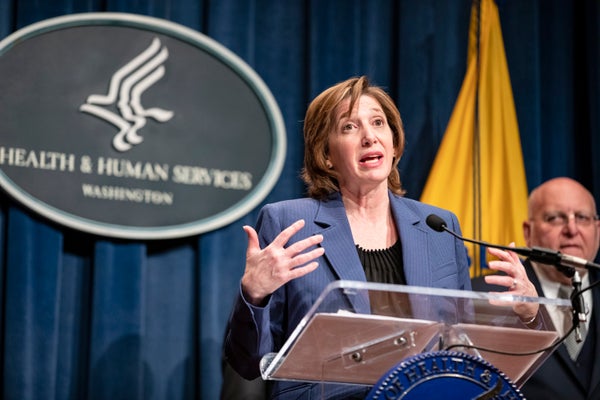
“As we’ve seen from recent countries with community spread, when it has hit those countries, it has moved quite rapidly. We want to make sure the American public is prepared,” Nancy Messonnier, director of CDC’s National Center for Immunization and Respiratory Diseases, told reporters.
“As more and more countries experience community spread, successful containment at our borders becomes harder and harder,” she said.
On supporting science journalism
If you're enjoying this article, consider supporting our award-winning journalism by subscribing. By purchasing a subscription you are helping to ensure the future of impactful stories about the discoveries and ideas shaping our world today.
There have been 14 cases of the virus diagnosed in the U.S., all in people who traveled recently to China or their close contacts. Another 39 U.S. residents have been infected in other parts of the world before being repatriated and quarantined. But CDC officials say the country could soon see more cases as the virus starts to spread through communities in areas outside China, including Iran, South Korea, and Italy.
The CDC urged American businesses and families to start preparing for the possibility of a bigger outbreak. Messonnier said that parents should ask their children’s schools about plans for closures. Businesses should consider whether they can offer telecommuting options to their employees, while hospitals might need to look into expanding telehealth services, she said.
“Disruption to everyday life might be severe,” Messonnier said, adding that she talked to her children about the issue Tuesday morning. “While I didn’t think they were at risk right now, we as a family ought to be preparing for significant disruption to our lives.”
The CDC’s messaging seemed to be at odds with the position of the World Health Organization, which reiterated Tuesday that countries could stop transmission chains if they acted swiftly and aggressively.
Bruce Aylward, a senior WHO official who led a recent international mission to China to see how that country had dealt with Covid-19, the disease caused by the coronavirus, said the lesson from China was that the impact of the new virus can be dramatically curtailed. But countries have to be prepared to wage a full-on assault, he insisted.
“Think it’s going to be there tomorrow,” Aylward said during a briefing for journalists at WHO headquarters in Geneva. “The thing you’ve got to think is: If it hits us, we’re going to stop it. You have to think that way. I keep hearing, ‘Oh, if it hits us we just have to accept it and it’s going to spread.’ Why? You’ve lost before you’ve started.”
Messonnier said the CDC is evaluating data on measures that could be used to stem the spread of the virus, including school closures and other social distancing strategies, voluntary home quarantines, and surface cleaning methods. The CDC is using data from past flu outbreaks to study those strategies, but will tailor its recommendations for the new virus.
Messonnier said the CDC is also in conversation about whether to change the case definition that triggers a sick patient to be tested for the virus. Currently, health officials recommend testing only for people who have respiratory symptoms and have recently traveled to China, or those who have been in close contact with someone who was infected. But as community spread picks up in other countries, the case definition could change.
Republished with permission from STAT. This article originally appeared on February 25 2020